PARENTING WITH IMPACT PODCAST
Befriend Your Brain: Parenting, Compassion, and Practical Neuroscience with Dr. Rachel Barr(podcast#251)
What if the secret to thriving isn’t fixing your brain but befriending it? Neuroscientist Rachel Barr shares powerful insights on how curiosity, compassion, and small daily shifts can unlock calm, clarity, and confidence. Discover why pushing harder keeps you stuck and what actually helps your brain work for you. Tune in to learn how to make your brain your greatest ally starting today. Befriend Your Brain: Parenting, Compassion, and Practical Neuroscience with Dr. Rachel Barr Amazon Music | iHeart | Spotify | Apple Podcasts | TuneIn | Youtube Rachel Barr is a neuroscientist, science communicator, and author with over a million followers across social media. She holds a master’s in molecular neuroscience and is completing her PhD on memory formation during sleep. Passionate about demystifying brain science, Rachel creates engaging content that bridges academic research with everyday life, empowering audiences to make informed choices about mental health. Her playful storytelling makes neuroscience accessible and entertaining, establishing her as a standout voice in science communication. Rachel’s first book, How to Make Your Brain Your Best Friend (DK), has recently been published in the UK and US. Dr. Rachel Barr I found my way to neuroscience. I actually initially, after doing a sports physiology undergraduate degree, jumped from there into a master’s in molecular neuroscience. I never expected to go to university. That wasn’t in the plan for me. I just didn’t ever envision that happening. I didn’t think I was clever enough. And so I just went and got incredibly bored, started working my way up the retail chain, started making a little bit more money so I wasn’t on minimum wage, and it just occurred to me that it wasn’t really going to be enough for me. From there, I found my way to a sports physiology degree, did that degree, realized I hadn’t quite picked the right subject, and decided I was going to use that as a stepping stone into a master’s. I looked for all the master’s courses that were kind of local to me around universities close to me, found the curriculum for neuroscience, and I just knew that was going to be it. I got so excited reading the curriculum. I couldn’t wait to get my hands on it. Rachel Barr Though I didn’t know it at the time, retrospectively, as I got to know the cohort, the other neuroscience students, I realized that quite a few of us had come from families where mental illness had impacted us or the people we were living with growing up. For me, I watched my mom struggle with her mental health all my life, and sadly, in the end, she didn’t survive it. I think lots of people in psychology and neuroscience are there because we want to understand our loved ones and save them, even the dead ones. I think there was some of that going on, and that feeds nicely into my motivation for the book because when you lose somebody to mental ill health, it feels preventable. You’re left with all the things you wish you’d said and done and tried, all the things I wish I could have made her understand about her brain and finding reasons to stay despite living with her mental illness. Dr. Rachel Barr I decided to write it into a book. I felt like books are like little time machines, aren’t they? I wanted to put that somewhere. So the book is kind of my love letter to her and to every brain that reads it. Elaine Taylor-Klaus And it’s a beautiful story. Yeah. Dr. Rachel Barr Thank you. Elaine Taylor-Klaus Yeah. Poignant. Important. Profound. And I agree with you. I think so many of us are doing this work because we’ve been personally impacted in so many different ways, and we want to prevent the next generation from suffering in the ways that we did. Dr. Rachel Barr Yeah. And that’s lovely. It’s a very human impulse to want to make the world a slightly better place than you found it. Diane Dempster That word suffering kind of stands out for me. I’m imagining that’s a big part of what you talk about in the book. What is your take on what’s important about being in relationship with your brain and your struggles as a human? Dr. Rachel Barr The reason I called it How to Make Your Brain Your Best Friend is sort of deliberate. All the way through the book, I anthropomorphize the brain like it’s a little pet that you’re charged with caring for. Partially because a lot of the conversations we’re having about mental health and the brain, especially on social media or in public spaces, first of all have nothing to do with what I know about keeping a brain healthy, and secondly, are quite hostile. They’re adversarial. There’s this idea that you should be able to use blunt force willpower to muddle through, to hack your brain into submission. Elaine Taylor-Klaus Submission. You do what I tell you to do, brain. Dr. Rachel Barr Yeah. Even though it goes against everything that comes naturally to you, feels horrible, and you hate it, tough luck. Try harder is often the advice we’re being given in wellness spaces or personal growth spaces. And I know this is a parenting podcast, but the absurdity of that mentality becomes instantly clear when you apply it to any other living thing. If your child is struggling or your pet, your dog, is struggling, you don’t think about how to whip them into submission or hack them into behaving. You try to understand their struggle. You try to understand their distress and provide kindness and care. My hope is that describing the brain as this little external pet you’re charged with caring for naturally changes people’s approach to self-care and helps them see how much of the advice we’re being given is actually quite hostile to us. Diane Dempster I think about even kids, and I know you work mostly with adults, Rachel, but so many times kids will say, “Well, I just need to try harder. I just need to do…” and they create that story for themselves, or they hear that message externally even as a child. Dr. Rachel Barr Yeah. I mean, it’s so often the case, especially with kids who are neurodivergent, that the correction or the solution to their struggles is just “try harder.” Just try harder. Why can’t you just obey? And that’s rarely a successful strategy even for us adults. If you want to make a change in your life, that blunt-force willpower, just do it because I say so, doesn’t really work. Willpower is in very short supply for us imperfect human beings. We get much more out of fixing the conditions that we’re in, like fixing our environment so that it’s conducive to our success, finding ways to enjoy what we do, enjoying the things we do. That’s much more sustainable than this approach of “try harder,” which rarely works. Elaine Taylor-Klaus True. And I think one of the reasons we gravitate toward coaching is because it offers us a process for problem solving for ourselves with some compassion and gentleness. Before we go into that and talk about strategies and neurodiversity and all of that, I’m really struck in this conversation by the compassion you are bringing for what it is to struggle with living with a brain that doesn’t do what you think it should or what the world thinks it should. In our community, the parents and the professionals, it’s always this dance between what the world expects of our kids and what they are capable of doing right now. Not that they won’t ever be able to, but how do we help enroll them and guide them in their own success? Elaine Taylor-Klaus There’s this fundamental compassion I hear in your understanding of what’s hard that I think is often missed. And so I want to talk a little bit about that, but I also want to talk about what makes it hard to take care of ourselves. First, let’s talk a little bit more about this notion you’re sharing that I think a lot of people have a hard time getting their head around, which is that it’s not that we won’t or that we aren’t doing what we should do, but that there are actual natural impediments. Can you speak to that a little bit? Dr. Rachel Barr Yeah. I think it’s easy for me to apply that compassion having gone through it. Like I said at the beginning, I never expected to go to university because I spent all of my educational years believing that I was stupid and obstinate and attention seeking, and all the other common accusations that are made of neurodivergent children. So I thought that wasn’t for me. And what a waste, what a shame, because I came to find as an adult that learning is my number one favorite thing to do. I love to learn. You can’t pull me away from it. Actually, I have to repel its advances at times. I love learning. I just wasn’t really set up to do that at school. Dr. Rachel Barr I think that lived experience allows me to empathize directly, even with people who don’t have mirror-image struggles to mine, because neurodivergence is diverse. Somebody with ADHD might not be the same as somebody else, and so on. But also other struggles, other mental health diagnoses, other life circumstances. I think it’s made it easier for me to understand that not everybody is working within the same parameters. And I think there’s a moralistic dimension to this. A lot of the telling-off of ADHD, autistic, or otherwise struggling people comes from a place of moralistic posturing, which is really unhelpful. Dr. Rachel Barr Threats sneak in the back door. With the internet, for example, it was misinformation and techno-feudalism. We were worried that people weren’t trying hard enough to learn, that we’d made access to information too easy and therefore somehow bad. I think it’s the same with accommodating neurodivergent kids. There’s this idea of morality around it, like why can’t you just try a bit harder, and effort becomes a virtue in its own right. But really, it should be about human beings thriving, about allowing each other the conditions we need to flourish and getting the most out of people. Instead, it’s so often clouded by moralistic posturing and judgment, sadly. Elaine Taylor-Klaus Yeah, it’s so true. I used to say to my son how impressed I was that he didn’t let school get in the way of his education. Dr. Rachel Barr Yeah. The education paradigm that we’re working with is a disaster. Diane Dempster I know you wanted to go a different direction, but we’re kind of here. You were talking, Rachel, about fixing the environment as a tool, and you were also talking about your love of learning and how important that was for you. One of the things I’d love to talk about is this: if you could go back and talk to your fifth- or sixth-grade self, what are the things you might do to strengthen that love of learning back then, knowing what you know now as an adult? Dr. Rachel Barr I don’t know if the most effective advice I could give her would have been permitted. For me, being stuck in a lecture hall with 20 or 30 other kids, just listening and trying to follow along, once you lose attention, you’ve lost the plot. That’s just not a format I can learn in. It was almost a waste of my time to go to those lectures. I think I would’ve told myself not to go to the lectures at all and just go home. Autodidactic learning is my way forward. It’s the only way I can properly engage with material, by going at my own pace and following my brain where it wants to go. I don’t know if things have changed in education since I went to school, but I doubt kids at the high school level would be allowed to say, “I’m not going to get anything out of this lecture, can you just give me a synopsis and let me go learn it myself?” I don’t think that would be allowed, would it? You probably know more about the system than I do. Diane Dempster I think there probably are some school environments, but as a general rule, no. Elaine Taylor-Klaus I do think there are environments where this happens more, especially at the university and graduate level. Because information is so accessible now, there’s more emphasis on what you do with the information, and I hope that continues. Dr. Rachel Barr I’m glad to hear that, but the trouble is, if we’re not implementing that same flexibility in primary and high school, a lot of kids don’t make it to university at all. Diane Dempster One of the things Elaine and I talk about a lot is creating problem solvers. The phrase “figure it out” came up for me. Even if we’re not yet able to change school systems, we can create environments where “let’s figure it out” becomes the default language. The mower’s not working, we still need to mow the lawn, let’s figure it out. That energy of doing something differently and working it through is what I’m hearing from you. Is that fair? Dr. Rachel Barr Yeah, I love that “let’s figure it out” approach. What I observe in school contexts, mostly universities now, is that we’re good at telling kids nobody can tell you what you can’t do, which is true and helpful. But I think we’ve moved past the point where that alone is enough. We also need to remind kids and adult learners that nobody can tell you what you can do either. Each individual learner has to figure out those boundaries for themselves. You’re not capable of absolutely anything, but you can do probably more than you know. And so you have to at least try to figure it out, see where that learning process takes you. Over time, you kind of recursively update your model of what you’re capable of and what is an absolute limit for you. Where are those boundaries? Unfortunately, this “you can do anything” approach sometimes masks the other side of the spectrum, which is that there are hard limitations. There are going to be things that you just can’t do, and that’s fine. We’re a species of delegators. Get somebody else to do that. We’re supposed to share tasks around. You don’t have to be good at everything, but we tell kids that they should be. I think we also inhibit that process of exploration by getting them to a point where they don’t believe in themselves, by destroying all sense of self-confidence and self-efficacy. Then that space of “I absolutely can’t do it” expands over everything. It becomes “I can’t do anything,” and it ends up being this mess that’s exactly the opposite of what you just described, where people feel like, let’s figure it out together. Maybe that means you upgrade your skills and eventually do it on your own, or maybe it means I make accommodations for you as an educator to work around what you cannot do. Elaine Taylor-Klaus Yeah. We like to say that our kids, the complex kids, are specialists in a generalist’s world. Dr. Rachel Barr Yeah, totally. Elaine Taylor-Klaus What you’re describing is that if we play to their specialties, play to their gifts, and allow them to feel the self-efficacy of their gifts, without expecting them to be brilliant at everything, then by following their talents and interests, we buoy their self-esteem. That has this positive cascading impact. That’s what I’m hearing you describe. Dr. Rachel Barr Yeah, you put that so much better and more concisely. That’s exactly it. Elaine Taylor-Klaus Got your concept. So let’s take a break and we’ll be back. Elaine Taylor-Klaus We are talking to neuroscientist Rachel Barr, who has written a book called How to Make Your Brain Your Best Friend. Let’s talk a little bit about what that actually means. What does it mean to befriend your brain? What does that mean for you? Dr. Rachel Barr A few things. I briefly mentioned this before, but it’s about approaching self-care through developing habits of kindness and care. That’s it. There are no hacks. There are only habits of kindness and care. Then there’s also meeting your brain where it is. Instead of trying to meet challenges with brute-force discipline, or the “just don’t give in to cravings” or “don’t think of a red balloon” advice, which sounds good on social media or in self-help books but isn’t advice humans can actually use. A lot of what I’ve tried to build in How to Make Your Brain Your Best Friend is a kind of compendium that says: this part is up to your brain. You have no control over this. These are your brain’s whims, and it’s going to follow them whether you like it or not. So how do you live with that? How do you work with that? How do you turn that to your advantage? How do you turn that whim, what’s often framed as a flaw in a generalist, capitalistic world, into something that becomes a source of joy and flourishing for you? It’s a bit of an anti–self-help self-help book, because I don’t care about your productivity. I’m not trying to make you more productive in a capitalist sense. So much wellness advice is actually about squeezing more labor or attention out of us, and that’s not what this is about. Elaine Taylor-Klaus Ourselves more time for work and effort. Dr. Rachel Barr Yeah. Be more efficient so you can squeeze in yet more work from your drained body and mind. A lot of it is about productivity. So I wanted to counter that and really focus on what are the ways you can work with your brain, not against it, in a way that will actually make your life feel like it’s more worth living. Personal growth shouldn’t be about being the absolute best, or a glossy makeover, being gorgeous and very successful. That’s not what personal growth should be about, and I’m very skeptical of claims that that actually leads to a happier, more fulfilling life anyway. I’ve tried to redirect attention to the stuff that actually does make life worth living and give advice that should feel good to follow. You won’t find any cold plunge–type, run-a-marathon advice where you’ve got to persuade yourself every morning to do something you hate because studies say there’s a 0.0001 percent lift on some physiological metric you’ll probably never even see the benefit of. It should all come naturally. Most of what the brain needs to be happy and healthy, and most of what you, the human host, need to realize your potential and actually enjoy the life you’re living, most of it does feel good. That’s what I’ve tried to offer up in this befriending of one’s brain. Diane Dempster Well, there’s an unraveling there, right? Because part of what we’ve got is this definition that we’re living with, that most of us have inherited, of what makes us happy. Society is defining what makes us happy, and then we’re using that as our measure instead of what you’re describing, which is let’s go in and figure out what happiness actually feels like. When am I happy, instead of when does the world say I should be happy? What does my brain need to get into that state? Dr. Rachel Barr Yeah, exactly that. And just a small caveat, what about when I’m not happy? Because life is complex. You can’t be happy all the time, and that’s actually fine. But how do you survive that kind of thing? So much of this comes from cultural scripts. You come into the world with absolutely no knowledge whatsoever, and we borrow those cultural or social scripts just to start building a human. But we’re so strict about them. Social media has a lot to answer for here, because normally as you grow up, you’re trying on different identities for size, different hobbies, scoping out the boundaries of what you want, what fulfills you, what doesn’t, borrowing from a cultural script as a starting point. Now, from so early on, we’re existing in what is really a marketplace masquerading as a social space. Human social learning is the bedrock of how we learn. We look at each other, internalize information unconsciously, and often imitate unconsciously. Social media floods us with signals about how people are living their lives, how they explore and communicate identity. We take all of that in whether we realize it or not and try to imitate it. Those are commercially colonized signals of identity. They have nothing to do with building an identity and even less to do with building a happy or fulfilling life. Elaine Taylor-Klaus It’s existential in a lot of ways. Maybe crisis is too strong a word, but there’s this existential question of how we’re in relationship with each other, with our cultures and communities, in the context of social media, in this world, with an education paradigm designed toward productivity and factory workers instead of self-love and personal expression. It sounds huge and existential, and I want to bring it back down, because I also know that your work is actually very practical and actionable. Dr. Rachel Barr I mean, existential crisis is certainly a phrase that features often in my conversations and content and stuff. It is an existential crisis. And I think the problem is then, as you say, it’s so big that people slip into a feeling of learned helplessness. It’s too big of a problem that we can tackle. As you said, I’ve really tried to condense that down into something that feels approachable. I wrote a chapter, boldly titled The Meaning of Life, but it isn’t a massive existential challenge to read. It’s simplified. Why does a brain want meaning in the first place? Why do human beings need a sense of meaning and purpose? When you boil it down, it’s fairly simple. We’re social animals, and our own internal experience isn’t enough for us. We need to affect things outside of us. When you put it like that, it becomes a remarkably simpler challenge. You don’t have to be a world-changing activist or a Nobel Prize-winning scientist. You can just be kind to people every so often, or plant some wildflowers for the bumblebees. It’s that simple. That will satisfy your brain’s need for meaning and purpose. It can be that small. Throughout the book and all my content, what I’m trying to do is bring first-principles education about people’s brains so they can use that to take care of their brains. When I do give practical advice, I try to make it small and not like an existential challenge, because we’ve got enough of that. Elaine Taylor-Klaus I feel that. I hate to have to stop the conversation, but we do have to start wrapping it up. For those of you interested, you can find out more about Rachel at Dr. Rachel Barr on Instagram. Her book, and we’ll have the link in the show notes, is How to Make Your Brain Your Best Friend. In addition to the book, she’s got a lot of social content on social media, on Instagram and TikTok. Dr. Rachel Barr Yeah. Elaine Taylor-Klaus So if you want to find out more and explore a compassionate, self-loving way to be with your brain, I encourage you to check her out. Thank you for the work. It’s really refreshing and lovely to have you. Dr. Rachel Barr Oh, thank you. Thanks for having me on. Elaine Taylor-Klaus Is there anything else we haven’t talked about that you want to speak to briefly, or something we have talked about that you want to highlight before we wrap? Dr. Rachel Barr No, I felt like that was a very natural conversation. I just wish I’d had a bit more time to hear about your coaching and how your methods feed into everything that I talked about so far. Do you want to take this moment to shine instead? Diane Dempster No, I think the thing that stands out most is compassion. As parents, we get stuck in this space between understanding that our kid is having a hard time and feeling the pressures of the world, our own achievement, and their future. We end up in this double sandwich. We’re feeling pressured, and we’re feeling pressure for our kids, and it’s hard to stay in compassion because of that pressure. Compassion is one of our key tools, and it’s really hard to stay there. Elaine Taylor-Klaus I really appreciate the conversation. I love this last piece you talked about, how simple our “why” can be. The secret to what we do, Rachel, is that we teach a neuro-informed, emotional-regulation-informed coach approach to parents and professionals. We teach them how to use those skills to down-regulate, to witness their kids, to pull back, and to enroll their kids in their own life process. We sneak in self-care in all kinds of ways. There’s a lot of synergy with what you’re talking about and the way we teach it. Very similarly, because we see this world of people struggling with neurodiversity, my story is similar to yours. I really thought I was stupid, and it was probably almost into my forties before I realized that wasn’t true. Our work is about creating an environment for adults to set kids up for success, to see themselves and understand themselves well enough to manage themselves in a loving, self-compassionate way. Dr. Rachel Barr I love that. Yeah. So Elaine Taylor-Klaus I, I really honor what you’ve done. I cannot wait to send your book to my kids. Who are young adults, and I really wanna thank you for being in this conversation because it’s, it’s so important. It’s so important and it’s so impactful. Dr. Rachel Barr Thank you. Yeah. Thank you so much. And, and thank you for doing all that you’re doing. As you say, I mean, people are really struggling parents of neuro neurodivergent kids, even if they’re getting it exactly right. The balance of all the challenges just makes it kind of. Recursive struggle. So yeah, I’m, I’m really glad to hear that people working on this and the way that you are working on it. Diane Dempster Well, and just to say it out loud, parents, none of us are. Rachel, as we get ready to close, do you have a favorite quote or a motto that you’d like to share with our audience? Dr. Rachel Barr Oh, yeah. You, you did, uh, give me prior warning of this and I, I’ve, um, haven’t been thinking about it. The, the only one that springs to mind, there’s a quote I should have looked up. It’s gonna have to be paraphrased the quote by Catlan Moran, which is something like, it’s a million times easier to wield a sword and shield cynical than it. Stand there with a balloon and a birthday cake with the infinite potential to look foolish. And I come back to that a lot because. We are social creatures. If we’re one thing, it’s, we’re, we’re incurably social creatures. Even those of us, like me who are autistic and, and struggle a bit more with that, we are social creatures and everything kind of hinges on our ability to be vulnerable and to try with, with an audience, which is terrifying. And I think a lot of people just kind of retreat into cynicism and like the moralistic posturing I was talking about earlier. ’cause it’s easier to, to wield that sword and shield. It is considerably more terrifying to stand there with a balloon and a birthday cake, uh, with the infinite potential to look foolish. But I, I think we must continue to try, uh, to do that. Elaine Taylor-Klaus I love that so much. Dr. Rachel Barr Is this one of my, I I was like, I have to just think of a quote. Google it. It’s only one I can think of in my, we’ll get the correct, we’ll Google it and we’ll get it in the, in the blogs. That’ll be, I’m trying to picture it. Yeah, yeah. Elaine Taylor-Klaus But if you’re saying it, I’m watching my eldest child who is always in that dance of, um, of, of, actually, I think their exploration is making themselves look sometimes as foolish as possible in, in order to comfort. Way, if that makes sense. Dr. Rachel Barr So that’s beautiful. Elaine Taylor-Klaus It’s beautiful. And as a parent it takes a lot to learn to be with that. Dr. Rachel Barr Sure. Right. Yeah. Elaine Taylor-Klaus So my friends, um, first of all, Rachel, thank you again. Any, any final words from you before we wrap this conversation? Dr. Rachel Barr Yeah. And just thank you so much for having me. This was lovely, lovely to eee you both. Elaine Taylor-Klaus Yeah. Diane, you wanna wrap us? Diane Dempster Yeah. So parents, as you’ve been listening to this conversation with Rachel, what’s an aha? What’s an insight you wanna grab for yourself to take back into your week, into your family, into your day? What’s coming up for you as you’re listening to us? Elaine Taylor-Klaus And maybe how do you wanna take that action and move it forward with you into your life this week? And as always, friends, thank you. Thanks for what you’re doing for yourself and for your kids. You make an extraordinary difference. Take care everybody. We’ll see you on the next one. Diane Dempster Thanks everybody. Thanks, Rachel. Elaine Taylor-Klaus Thank you. 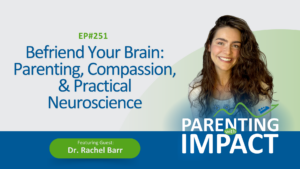
What to expect in this episode:
Find Parenting with Impact on your Favorite Player:
About Dr. Rachel Bar
Connect with Dr. Rachel
Related Links:
Connect with ImpactParents:
Our Discussion

Find Parenting with Impact on your Favorite Player:
Amazon Music | iHeart | Spotify | Apple Podcasts | TuneIn | Youtube