PARENTING WITH IMPACT PODCAST
How To Help Young Adults with ADHD Find the Right Support with Dr. Zachary Gershon (podcast#270)
Wanting to support your growing ADHD kid and knowing how to support them are often two very different things. As teens and young adults push for independence, even well-meaning advice can feel controlling, creating more resistance and disconnection. In this episode, Dr. Zach Gershon explains why peer support and community can be life-changing for young adults with ADHD, and how parents can shift from managing their child to becoming a trusted source of support. Press play to discover how connection, autonomy, and small wins can help young adults build confidence and move forward on their own terms. Download a free tip sheet "Recommended Treatment for ADHD: Medication & Behavior Management" for what's really recommended for your child or teen. How To Help Young Adults with ADHD Find the Right Support with Dr. Zachary Gershon Amazon Music | iHeart | Spotify | Apple Podcasts | TuneIn | Youtube Dr. Zachary Gershon is a twice-exceptional neuroscientist based in New York City whose work explores the intersection of neurodiversity, cognition, and human behavior. He earned his PhD from The Rockefeller University, where his research focused on neuroscience and brain function. Drawing from both scientific expertise and lived experience as a twice-exceptional individual, Dr. Gershon is passionate about advancing conversations around neurodivergence, learning differences, giftedness, and mental performance through research, speaking, and advocacy. Dr. Zachary Gershon Elaine Taylor-Klaus Dr. Zachary Gershon Elaine Taylor-Klaus Dr. Zachary Gershon Elaine Taylor-Klaus Dr. Zachary Gershon Elaine Taylor-Klaus Dr. Zachary Gershon Elaine Taylor-Klaus Dr. Zachary Gershon Elaine Taylor-Klaus Dr. Zachary Gershon Elaine Taylor-Klaus Dr. Zachary Gershon Elaine Taylor-Klaus Dr. Zachary Gershon Elaine Taylor-Klaus Dr. Zachary Gershon Elaine Taylor-Klaus Elaine Taylor-Klaus Dr. Zachary Gershon Elaine Taylor-Klaus Dr. Zachary Gershon Elaine Taylor-Klaus Dr. Zachary Gershon Elaine Taylor-Klaus Dr. Zachary Gershon Elaine Taylor-Klaus Dr. Zachary Gershon Elaine Taylor-Klaus Elaine Taylor-Klaus Dr. Zachary Gershon Elaine Taylor-Klaus Dr. Zachary Gershon Elaine Taylor-Klaus Dr. Zachary Gershon Dr. Zachary Gershon Elaine Taylor-Klaus Dr. Zachary Gershon Elaine Taylor-Klaus Dr. Zachary Gershon Elaine Taylor-Klaus And that’s really what you’re speaking to, is that we have to take responsibility for our impact. Even if we didn’t mean to cause harm, we still want to take responsibility for our role in the dynamic. And I think oftentimes we as parents forget how important it is to say, “Wow, I’m so sorry, I didn’t intend that,” instead of saying, “Well, but I was just trying to…” Right? The shift of that. Every kid in the world wants to hear their parents say, “I’m sorry,” if it’s genuine and authentic, because that means that they’re feeling seen and heard. And that’s really what you’re speaking to. I think underneath all of it is we want to be seen, we want to be heard. Dr. Zachary Gershon Elaine Taylor-Klaus Dr. Zachary Gershon Elaine Taylor-Klaus Dr. Zachary Gershon Elaine Taylor-Klaus Dr. Zachary Gershon Elaine Taylor-Klaus All right. Thank you, my friend. Thanks for being here. To those of you listening, next up on the podcast is going to be a member success story, so stay tuned for the next one. As you’re listening and thinking about the conversation we just had, what’s your takeaway from this episode? What’s one insight that you’re taking away that you want to bring forward with you into your week, into your dynamic with your kids, with the young adults in your lives, with the young adults in your practice, whatever role you happen to be listening through that lens? What are you taking away from this? And as always, thanks for what you’re doing for yourself and for these amazing young people. They’re going to be amazing, full-blown adults. We just have to help them get there. At the end of the day, what you’re doing makes an enormous difference. So thank you for what you’re doing. If you like what you’re hearing on this podcast, please take a moment to follow or subscribe wherever you’re listening. Even better, leave a review. Anything you can do will help us reach the people who need it most. So thanks for tuning in. We’ll talk to you next time. Download a free tip sheet "Recommended Treatment for ADHD: Medication & Behavior Management" for what's really recommended for your child or teen.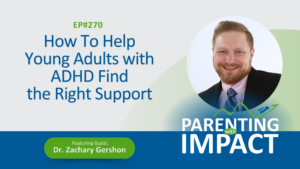
Article continues below...
Treatment for your Child's ADHD
What to expect in this episode:
Find Parenting with Impact on your Favorite Player:
About Dr. Zachary Gershon
Connect with Dr. Zachary
Related Links:
Our Discussion
I started out actually as somebody who had no interest in a support group whatsoever. And I was diagnosed at the end of my college career. I was headed straight to grad school, and it was around that time that four out of five members of my nuclear family got diagnosed with ADHD. And funny enough, it was the one who didn’t have ADHD that found the support group. It was a support group for partners of individuals with ADHD who were not ADHD themselves. And this is my mom, and she said, “Why don’t you try a support group?” And I was so against it. I refused, refused, refused. And finally, you know, like any good Jewish mother, she wore me down and-
I have an objection. I’m sorry. Okay, you can continue.
Objection noted. And, you know, she, I will say, was right. I was wrong. I went to that first support group, and I had this all-consuming feeling of, oh, it’s not just me. There are others out there whose brain works like mine. And of course, this was before the age of TikTok where everybody is seeing all of this content. But even now it’s different watching it than having a conversation with somebody who’s experiencing it in real time. And so I had that eye-opening moment, and I kept going back. And at this time it was ADDA’s support group for college students. And at the end of the academic year, the facilitators who were all professional coaches said that we would take a summer hiatus, but they weren’t sure if they were going to be able to continue the group the following academic year. Just because of professional responsibilities, they were volunteering their time. Everybody who facilitates groups at ADDA are volunteers.
Yes.
And so about a month and a half into the summer, I felt like there was something missing in my life. I felt even more so that the people around me just didn’t get it, and that this four or five months that I had spent on the phone talking to these strangers who also had ADHD about what their struggles were and how they were similar to mine actually meant a whole lot to me. Mm-hmm. And so I reached out to ADDA and I was like, “Is there any way that we can find people to bring this back?” And they came back to me and said, “We are happy to provide a platform for you, but we don’t have the volunteers right now. Would you be interested in getting trained to facilitate and leading it yourself?” And I said, “Well, if that’s what I gotta do to make this happen, that’s what I’m gonna do.” And so I started the group, and it’s evolved over the last, let’s see, we started in July of 2017, so it’s been almost nine years. To get to the crux of your question of why do I do what I do-
Well, no, first describe what is it that you do. So since 2017, you’ve been running-
This support group, and it’s held on Zoom. We start where we go around and introduce ourselves. We introduce ourselves with a win from the week. And that can be anything from, “I reorganized my kitchen pantry and it is now usable and understandable. I put away all my laundry,” to even something like, “I got out of bed less late than I was worried I was going to today.”
And I’m guessing you have a fair amount of, “I made it this week, I’m here.”
Oh, yeah, that is one of my favorites.
Yes. There’s a lot of community too. Let me just button this so we can move on in the conversation. So it’s a support group for emerging adults, young adults.
Yeah, so it’s… We like to say that we’re a group for people from 18 into their 30s.
Okay.
And I think that you hit that developmental piece of ADHD, that sometimes people feel younger than their chronological age.
Absolutely. And how many? So is it multiple groups? Is it one group? How many people?
So it’s one group that runs the second and fourth Tuesday of the month. That’s the support group, and we usually get anywhere from 15 to 25 on average. Occasionally, when we bring in a guest expert, we’ll have attendance into the 30s sometimes. The second and fourth Tuesday is a support group, and then we also started running, during pandemic lockdown, a hangout group, which runs on the first and third Tuesday of the month. These are all at 7:30 Eastern. And that is just, you know, having more emotional support. The actual support group is great, but during the pandemic people were just needing a space to hang out and connect.
Yeah.
And so that’s really been a legacy of that. That tends to be a little bit smaller. I’d say on average about 10 people weekly, but we don’t have a cap. Everybody is welcome. And yeah, it’s really turned into this wonderful community where each support group session we have a discussion topic with some discussion questions that we provide. And everybody just shares from their own experience what it’s like dealing with having ADHD and looking for a job, what it’s like trying to go through the accommodation process. We’ve covered money and budgeting. We’ve covered emotional regulation. We’ve covered sleep hygiene. One of the recurring topics that keeps being requested is friendships and then romantic relationships. We talk about everything as it pertains to ADHD.
And I wanna reiterate that you were trained to do this, and the other people leading these groups are trained to do this. So this is not just a random group of people, but it’s people who ADDA has done the work to make sure that they are holding a safe space for people as they come in. And so I guarantee you there’s been training about how do you know when to make referrals and all kinds of things to make sure that it’s safe for the individuals as well as for the group.
Very true, yes. And we even have a set of ground rules that we start with about what the group is and what it is not. We’re always very clear that our support group is not coaching or therapy. No one should take from the group something that would cause them to change their medication regimen. Anything that they hear in group before implementing in that arena, always consult your physician. We’re very, very explicit that in group, we are adults. The facilitators have been trained, but we are just peers with ADHD, and we’re here to run a conversation about what our lives are like with ADHD.
It’s beautiful. All right, we’re gonna take a quick break, and then let’s come back and kinda dive into that next layer.
My guest is Dr. Zak Gershen, known to most of us as Zak, and, um, who leads, uh, the support group for young adults, roughly 18 to 30s, at CHADADA. That’s the add.org adult support organization for adults with ADHD. And, um, I, I wanna go back. You started, and I took a little objection, but you started because your mom found it, and you resisted at first. And, and in our work, we do a lot of work at Impact Parents with parents of young adults, and, and our message to parents is if you don’t have the relationship to, for the trust, uh, if you are forcing something on someone and they’re resisting, then it’s not collaborative. You have… You and I know each other, so you’ve got the relationship with your mom where even though she was pushing, you were listening, right? So talk a little bit about, ’cause you see people coming into this group all the time, how do, how do young people typically find the group, and what are the circumstances around their joining it?
So, um, we get People finding the group, um, from a bunch of different ways. Uh, you know, some people find it just simply through a Google search because I’ll tell you, um, that unfortunately if you look, if you Google ADHD young adult, we’re in, like, the top three search, um, parameters. And when I say unfortunately, I don’t mean unfortunately because I’m happy that, like, people are able to find us, but I mean unfortunately because there’s not a ton- Yeah out there. Um- Same with the- And we’re really one of the only resources specifically for this demographic. Um, you know, which is, which is why I think, um, it’s another part of why I do what I do. Um-
Yeah. Which is part of why Zach and I get along so well, because he’s one of the only resources for this demographic, and we’re one of the only resources for their parents.
Exactly.
Right? Similar scenario, because there’s just, it, the, the awareness of, of what it means to struggle with ADHD as a young adult is a relatively new awareness. You know? Yeah. 15 years ago, we, they weren’t even convinced that it, it continued into adulthood. Of course, we know that is true, that it does.
Exactly. Um, so, you know, there’s Google searches. We get coach and therapist referrals. We also get parents who find us and then suggest, you know, that their children, um, come join the group. Uh, so-
Do people tend to come in resistant?
No one will show up if they’re resistant. Um, that’s the, that’s the thing. Like, we And no offense, parents aren’t welcome i- in our group, right? Like parents of, of, of young adults are, are not welcome in the group because then it’s not a safe space for the young adults to share openly and honestly. Um, and so parents can try to force their kid onto it and, like, give them the computer for an hour, but, like, if the parent’s in the room, the kid might be there and lis- but, but they’re not engaging, they’re not participating, so they’re not really there. Right. Um, and then, you know, again, if they’re resistant and the parent is not in the room checking over their shoulder, they’re just not gonna show up.
Yeah. Yeah. So what is it, what’s that magic moment that helps a young adult go from, “I don’t wanna need this,” to, “Wow, I could really use this”?
It usually takes about five minutes of listening to the conversation, um, and how other people are talking about their experiences with ADHD, because I think that a lot of the time the resistance to the parents comes from a place of, how can you understand what I’m going through? How can you experience, understand my experience? Um, and a lot of that, you know, even if the parent does have ADHD themselves, young adults today are ex- are experiencing a completely different set of, you know, situations than what our parents were, right? Right. The cell phone, the internet alone is, you know, makes a massive difference. And so where, when the young adult, you know, the new young adult is listening, um, and even if they’re like, “Oh, I’m not sure if this is for me,” about five minutes in they start … You, you … If they’re on camera you can just sort of see, like, the b- the body language of them relaxing into themselves and being more engaged and they’ll lean forward a little bit, because everybody’s story resonates a bit.
Even if it’s not the exact same experience, there’s enough of a shared experience that, you know, when we end the group we always do our takeaways, like what is one thing that you took from today’s group? And for our newcomers, 99.999% of the time it’s, there are others like me, and I’m not alone. And we call that sort of the universal first group experience to the point where one of our members even made a little animation that they’ll hold up on their iPad when it happens, just to celebrate the welcoming of the newbie having that experience.
Well, what really strikes me is how parallel this is to the parents’ experience in our groups. And we’re not running support groups, we’re running coaching groups. But the parallels are so clear. It’s like we start with a celebration, we end with a takeaway. There’s a topic each week, right? So much of it is parallel because it’s really about creating a space for people to connect with others and also to have a conversation with themself. So talk about that a little.
So we really try to make it a space where people feel safe and comfortable connecting with each other and sharing openly and honestly. And a lot of the times, and this is one of the biggest things I’ve learned as a facilitator, is that sometimes we as facilitators need to model that. And I’ve had members in our group say, “Zach, I just don’t get it. I dropped out of college. I’m struggling to keep a job. I just don’t see much good in my life, and I don’t understand how you do it. You’ve made it through college. You did a PhD. What are you doing that I’m not?” And at that moment, I tell them, “I’ll tell you what I’ve done. I have failed as a facilitator and a leader in this community because I was masking unintentionally, but I was masking as this kind of person who has it all together, and I don’t.” And then I just rattle off all of the things that I feel I’m on the edge with, that I’m struggling with. Because part of the facilitation training is it’s not supposed to be about us. It’s supposed to be about allowing the community to have that conversation and connective experience. But sometimes you have to as the facilitator.
What you’re speaking to is your authenticity. Right, exactly. Like, when you step into your authentic experience, and you allow them to see it in service of them, not in service of, “Let me tell you all about me,” but in service of supporting them in their experience, that’s good facilitation. Right. And it’s a skill you had to learn.
Yes. Oh, yeah.
For sure. So, so we don’t have a lot of time left. I have one more major question. We have a lot of parents in our community who will be listening to this and thinking, “I really want my… How do I get my kid to? How do I get my kid to do this? I can see how much they’d benefit. I see that they need it. I want them to have this kind of support. I want to debunk the myths.” Like, from all of the best loving places, parents want their kids to get this kind of support. What’s your advice to them?
My advice would be, first off, if you push too hard, it’s not gonna happen. Because young adults, I mean, I think that this is one of the crucial things that all parents of young adults can really benefit from sitting with, is we’re in a major transition point in our lives, and a big feature of that transition is understanding ourselves as independent people. And so if we feel like we’re being told to do something, it’s not necessarily gonna be welcome. It’s probably not going to be welcome.
So I was reminded of this when I brought up things that we frequently say we wish our parents knew. I think it’s just as important as that invitation piece, is remembering that impact of actions and words matters to us as young adults just as much, if not more, than intention, especially in the moment.
Say that differently, because I’m not sure I understood what you meant.
How a parent’s words or actions are intended, if they’re intending to support. And I think a great example is the difference between the suggestion versus the invitation. In both cases, the intention is, “I want to support my child.” The impact of the suggestion is, “I’m being controlling,” or on the young adult side, “My parent is playing the puppet master.” Whereas with the invitation, the impact is, “Oh, this is a door that’s opening from somebody who’s curious and wants to listen to what I have to say and what I’m trying to do.” And it applies in scenarios beyond just the suggestion and the invitation. But that impact is real, and I think that can be a source of conflict because if harm was done and no harm was intended, right?
There’s still harm done.
There’s still harm done. And so approaching things with that in mind, and approaching things with your young adult with curiosity, I think will always be a welcome shift.
Yeah, for sure. One of the things, so we run three parent groups for parents of young adults, roughly 18 to 40, 35, something like that. And one of the things that I think we say a lot in that community is speaking to what you were just saying. It’s really about we have to get ourselves out of the way to be present to them and what their needs are, and it’s got to be about them, not about us. And you know, Beck said to me once, and I’ll never forget it, this was years and years ago when they were starting the public trans journey and what was going on. At some point they said to me, “I know that you’ve done your best, but that doesn’t mean it didn’t have an impact on me.”
Exactly. Exactly. And we want to feel like we are determining our own destiny in this. Yeah.
Yeah, and that’s so huge. And we have to get out of the way to allow that to happen, and sometimes that means we have to let go a little bit more. So much more on that. So Zach, thank you. I love, you know, we get to go to conferences together, and we have a good time, and I love what you’re doing, and I love what you’ve brought to the world and what a difference you’ve made.
Thank you. I so appreciate you saying that, Elaine. That really means a lot to me.
Yeah. And I know you know what the impact is, and I still want to acknowledge what a difference it makes. There are hundreds of young adults out there who get the support they need because you kind of looked around and said, “Well, I see a need. I guess I’m going to fill the need.”
I so appreciate you saying that, Elaine. That really means a lot to me. Thank you.
Yeah. So do you have a favorite quote or motto you want to share before we wrap?
I think that my favorite motto just comes from group, and it’s a reminder to celebrate the wins, no matter how small.
Yeah. Celebrate the wins, no matter how small. And I love that. When Diane and I started Impact ADHD originally, the very first coaching tip we shared was celebration. I used to call it “celebrate the victories, large and small.” So I love that.Treatment for your Child's ADHD

Find Parenting with Impact on your Favorite Player:
Amazon Music | iHeart | Spotify | Apple Podcasts | TuneIn | Youtube