PARENTING WITH IMPACT PODCAST
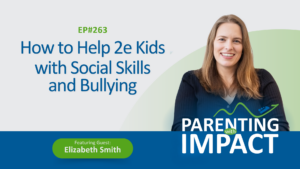
How to Help 2e Kids with Social Skills and Bullying with Elizabeth Smith (podcast#263)
Social struggles are not just about making friends. For many neurodivergent and 2e or “twice exceptional” kids, misunderstood social cues, complex peer dynamics, and hurt feelings can quickly turn into conflict or isolation. In this episode, Elizabeth Smith unpacks what is really happening beneath these interactions and how parents can guide their kids through them with greater clarity and understanding. Dive in to learn how you can help your child navigate social situations, respond confidently to teasing, and feel like they truly belong with peers. Take a quiz to find out what kind of a parent you are. How to Help 2e Kids with Social Skills and Bullying with Elizabeth Smith Amazon Music | iHeart | Spotify | Apple Podcasts | TuneIn | Youtube Elizabeth, a New York City-based social coach, has a deep-rooted passion for empowering 2e and profoundly gifted children. Her journey into social coaching was personal: she was working as a physician assistant in psychiatry when her own 2e child needed support. Elizabeth discovered the evidence-based PEERS program from UCLA’s Semel Institute. After obtaining certification, Elizabeth conducted further research into best practices for affirming neurotypes and strategies to avoid masking and forced behavior. This developed into her own strengths-based approach, utilizing empathy, acceptance, and current research to empower children to meet their own goals. Elaine Taylor-Klaus So, we had a beautiful opportunity in November. We were attending the International Conference on ADHD, as we are wont to do every year, every November. Over the next year, it’ll be December. And that is the conference where Diane and I met each other there for the first time. It is the conference where we launched Impact at the time Impact ADHD, and now Impact Parents. We have exhibited, we have presented, we have schmoozed and talked and cried and laughed and partied, maybe partied, maybe a little bit closed down some late nights. And last week, when we went this year, we had the opportunity to bring Natasha and Brittany to join us for this conference. And it was Diane Dempster Wait, Elaine, you just called them Natasha and Brittany, and they’re probably sitting in their chairs going, “Oh my gosh, are we in trouble?” That is Nat, we brought Nat and Brit with us to the pop. We did Elaine Taylor-Klaus We did. I was getting ready to go stand in the corner as the person who coordinates all of the communication on some level, and when and how. And then you’d probably know Brit because she goes by the team Diane Dempster It says right there. It says Impact Parents Team. Elaine Taylor-Klaus Yep. Team. That team at Impact Parents. If you’re writing an email at some point, Britt’s gonna be the one to figure out how to handle it or how to respond or how to get it to us. To mention that she also doubles as the Zoom fairy on webinars and workshops. Diane Dempster Yes. And mostly, both of them are people that we can’t live without. Right. They’re what make us work. And they work really hard and work behind the scenes, and we’re so very, very grateful to have them with us. Elaine Taylor-Klaus Oh, amazing. And so we got the first opportunity ever to bring them into the conference this year to join us. We had a booth for the first time since I think 2019, Diane for a long time, because it was kind of a special conference for us, which we’ll talk about in a little bit. And they got to meet each other for the first time in person after years and years and years of working with each other. Like, did we ever figure out how many years? I think approximately eight. Yeah, yeah, eight. Yeah. So like long before the whole COVID sent everybody working virtually, we’ve always been virtual since we started in 2011. And so we had the privilege of watching these two fabulous humans who well, you guys describe yourselves better than we could, about how you work together. But to watch them get to actually see each other in real life and real time in real person was really a precious moment for us. So what should we talk about for people listening in terms of what are we taking away from this conference this year? Like, what are this rather than oftentimes when we do this work, this podcast episode, we’re talking about what do we learn in the sessions? But I wanna pull us back to kind of a macro, to what do we learn from the experience of being at the International Conference on ADHD, which you two had never been to before. Natasha Skanes No, we I’d never been. Britt, you’d never been. For me, I think the biggest thing that I walked away from, the biggest learning that I had was what a community like. That is what I left thinking. Watching just a huge amount of people who are all together for one common purpose, working together as a community was pretty remarkable. There was an energy to the whole place. Yeah. That it it, I, I, I used the word energy, but it there was, there was like a humming, a buzzing to the whole place. You know, I think it’s pretty incredible when you have so many people come together working towards one common goal, and it was just pretty incredible to see it from that lens. I’ve always worked behind the scenes helping get materials ready, booth stuff ready and whatnot, but to see it live on the ground, to hear parents who are there that have been a part of our community for so long come up and share stories, about how, you know, Impact Parents or even Impact ADHD has impacted their lives. To hear stories from other of your colleagues, Elaine and Diane, that you guys have collaborated with over the years, to get to meet them in person, but to also hear them share stories about, you know, collaborations that you guys have been on together, and just see the full reach of Impact as being it was pretty remarkable. Elaine Taylor-Klaus Yeah. I get that. What about you, Britt? What came up for you? Britney Seago Yeah. So when Nat said energy like the energy was amazing. Yeah. And just the amount of people that, you know, that we met that I feel like I knew already, just because we’ve we have that relationship virtually. So it was just so cool to meet everyone, you know, in real life. You know, whether they were members or, you know, partners of ours, you know, other professionals that we’ve worked with. It was it was just really amazing. Elaine Taylor-Klaus Go Ahead. Diane Diane Dempster Walked into the hotel, right? It’s just sort of there’s like and I think, Britt, we should share the, picture collage thing that you did. Like, we can put that in the show notes or have that be the featured image or something so people can see it. But you walk into this big, giant hotel we were in Kansas City and there’s this sign that says ADHD 2025, and it was it was just this sort of warm and welcome and it just, you know oh wow, we’re here. And part of what makes this conference amazing is that there are a lot of people that have been supporting this community for as long as we’ve been in this community for 15 years. But there’s a group of people that have been around like we have for a really long time, and then there’s, you know, just this community they don’t know you. They’re like accommodating and open and warm and, you know, it it’s, there’s this, just this ener like you said it’s this energy of connection. Support, whether you know everybody, which we we know a lot of people there and a lot of people know each other, and even if they don’t know you, they’re your new best friend. Right. You really are two of those. Yeah. Elaine Taylor-Klaus Acceptance and non-judgment that just kind of permeates the hotel. It’s like you you’re at a hotel for three or four days, where you can talk to anybody pretty unabashedly. You can start like crazy conversations in the elevators because nobody’s really blinking twice about it because there’s this assumption that we’re, as you said, now we’re all in this together. Natasha Skanes We are, yeah. Elaine Taylor-Klaus One of my favorite pieces was when we first saw Nat and Brit together and they had seen each other at the airport, and so they’re like holding onto each other, hugging each other in the lobby when we when we got to see them, and the four of us got to meet each other in real life for the first time. And they are looking around the lobby going, I cropped their headshot. I fixed their headshot. I cropped their like they’re seeing all of our colleagues who have been guest expert and we have had, over the years, y’all, over 300 professionals who have been experts or guest experts or summits or, you know, who have worked with us over the years. And they were seeing all these people for the first time in real time too. So it’s not just we existed like in the flesh, but everybody did. Yeah. Natasha Skanes Right. It felt like a little bit of fangirling. I think I used that term while I was there, but I almost felt like I was at a film festival, or it was it was similar, I think, to meeting celebrities or something in person. ’Cause I’d only ever seen screen or print. And then I’m like, oh, you really do exist in real life. Yeah. Britney Seago Well, and I think part of are celebrities. Diane Dempster Yeah. Thinking about the people who are listening and kind of what they would wanna hear. And I think there were Bri, you said this it’s like we had professionals that we work with and then we there was also a lot of, parents and members of ours that were there. I think the question is like, what is it that you think drew people? And yes, if you’re there for professional development, that’s one thing. But there’s a group of people that are adults with ADHD that are there. Then there’s a group of people that are also parents that are looking for information and support for their kids. What do you think are the things that drew people, the parents that you were talking about talking to, to the conference? Natasha Skanes I think a consolidated place to feel connected to community for resources, for support. To share experiences with other parents. that’s what I take away from it like even, even myself who was there in a different capacity than, you know, some of the parents that we met and other professionals that we met. I know when my when I came back and I was chatting about it with my best friend, something that I said to her, which comes to mind right now, is that I somehow immediately felt like I belonged. Mm-hmm. I was there in a completely different capacity, but I picked up on threads of that in my conversations that I had with other parents, that were attending and professionals that were attending, is that seemed to be the common thread is a place where, you know, you don’t feel, isolated, that you can get support and help. And really just looking for some community. Diane Dempster So many of our parents are like out there, and they don’t have other parents who are going through the same sort of things. That’s part of what we love about Impact Parents generally. But you’re describing bigger, which is this sort of there’s this isolation, but when everybody’s together in the room, it feels completely different. Elaine Taylor-Klaus We are, uh, talking with Brit and Nat about the international conference on ADHD. They got to join us this year, and we were talking about what that experience was like, and we’ve been talking about the conference as a place of community and connection and and also you mentioned resource, Nat, and so what I was thinking about was talking about the different ways in which We as parents and professionals in this space, seek different ways to get the resources we need to do whatever it is we’re doing, whether it’s as parents or as professionals. And there was a lot of different ways that people can do that there, right? One of the ways is, is these big keynote sessions where everybody’s in the same room, right? And so you’re in a room with literally like a thousand people. And then there are all these breakout sessions. and then, then we were in the exhibit hall where there was a whole other thing going on. What do we wanna, what, what, what comes up right now as we talk about, like, the different kinds of experiences that we had while we were there. Britney Seago I’m not sure about the experiences as far as like the presentations. I did not go to any presentation, but the experiencing exhibit hall was, was something else just the amount of people that came by our booth, either because they were fangirling over Elaine and Diane and Impact Parents and they’ve been part of our community. Or they were parents that have never heard from us and they’re struggling and they needed support. So the amount of different people that we met was just, it was really cool to see, and, and talk to so many different people. Diane Dempster Or maybe they were just going to visit the puppies and they got distracted and they came over. Britney Seago Oh, as soon as the puppies came out, you know, the lines everyone went to the line for that. Diane Dempster And of course you guys know, it’s like if you’re gonna have a conference on ADHD, there will be puppies, there will be labyrinths, there will be miss. Elaine Taylor-Klaus It’ll be creativity. Diane Dempster Yep. Elaine Taylor-Klaus There’ll be art. Diane Dempster I mean, it was just, I mean Yes. All the things. Elaine Taylor-Klaus There will be a talent show. Diane Dempster Yes. Elaine Taylor-Klaus yeah, there, there will be yeah. Natasha Skanes Further to what Britt was saying, the exhibit hall was pretty special, but I think it was like there, it’s the amount of resources. I know myself as a parent and, you know, a, a working parent and running a household, I run out of time sometimes to actually, you know, do all the things that I want to, especially when it comes to, you know, extensive or thorough research uh, research, sorry on resources available to me on a variety of topics. So what I thought the conference did a really good job of was providing a variety of resources all in one place, whether you were somebody that would benefit more from attending a presentation and a breakout session, or from having a casual chat in the exhibit hall. I know that even just walking from the exhibit hall to my room, I passed parents in the hallways having conversations. It struck me that they had maybe just even met and maybe were in a session together and realized they had some shared experiences and were just chatting. So I think there was that in itself as a resource. So I think it’s something that works. It’s condensed. You can get anything that you’re looking for. It meets you where you’re at. You can take as much from it as you want, as little from it as you want, and add in some fun along the way. Elaine Taylor-Klaus Yeah, it’s so true. It is fun. I mean, it’s where else in the world can you hear somebody, while sessions are going on, walking through the hallway going, “Did anyone lose a pink phone?” Diane Dempster You know, there’s just it’s a conference with a lost and found. That was one of the things they were highlighting. Elaine Taylor-Klaus Yeah. There’s kind of a need for a lost and found. So one of the things that happened at this conference was Diane and I got recognized for the work of Impact. And part of the reason we were able to bring you in was because of that. And so I’d love your take on what it was like to see the impact of Impact. Like, you guys are the ones behind the scenes making it all happen, doing so much work that nobody ever recognizes. I mean, we try to, but, you know. What was it like to see the impact of the work you’ve been doing all these years? And I don’t know if you can see if you’re not watching you can see the right, both of them. Natasha Skanes Yeah. Yeah. it’s really kind of hard to put into words. I will start by saying that I was filled with so much gratitude for being able to be there and be a part of that with you guys, but to also experience firsthand the impact of Impact. And for me, I will say that that started before the ceremony even took place where you guys were presented with the award. Just watching people come up to you guys and greet you, whether it was parents in the community, other partners in the community. Just realizing the impact that you guys have on so many people in so many different capacities, and then in the ceremony itself I know I’ve mentioned this to you guys before, Elaine. You had a part of your acceptance speech where you asked everybody in the hall to put up their hands if they have been touched by Impact ADHD or Impact Parents at any point. And watching the number of hands go up was truly moving. It’s pretty incredible to see that many people and to feel a part of something that has impacted, in a positive way, so many people’s lives. It makes me feel truly lucky to be a part of this team. Britney Seago Yeah, agreed. I know I’m bummed. I was videoing the ceremony. I did not get to see all the hands go up. I know all the hands in front of me went up, but I did not get to turn around and see. And I wish we could have captured that because, like what Nat said, there were so many people in there that put their hands up to that. And just the amount of people that I mean, we could not walk from one end of the hotel to the other end of the hotel in less than 30 minutes with the amount of people that were stopping to want to talk to you guys like that. It’s just amazing. You guys have built this extraordinary community. Natasha Skanes Even just on our we Britt and I called them our press badges. Britney Seago Yes. Natasha Skanes But we all had conference name tags, and we were pretending they were our press badges. And on our conference name tags, it said that we were from Impact Parents. And even when we weren’t with you, Elaine and Diane, and people would stop and look at our name and say, “Oh my gosh, you’re a part of Impact Parents.” You could see that they were there was just a connection immediately when they found out that we were part of the team. And they were really eager to meet us, get to know us, find out what we did for the team. So yeah, you definitely immediately felt like I felt like I already know I’m part of something special, but to see it firsthand was, yeah Amazing. Britney Seago Pretty amazing. Yeah. Yeah. Elaine Taylor-Klaus And I loved getting to watch the two of you. We had this one night where we were hanging out. Diane, I think you had already called it a night. Wisely. Wise in that moment. And I was listening to the two of you talking. The way you described it was you were saying to somebody else we share a brain. And watching the two of you talk about how you work together as a team and how you support the team here, I was thinking a lot about the kind of neuro-informed way that we operate as a team. We recognize how each other’s brains work, and we accommodate for that, and we give each other space for that. And so before I know we have to start wrapping soon but does that bring up anything for either of you? Natasha Skanes I say this all the time. I could not imagine doing this without Britt. She is the other half of my brain. Even better than being able to do something that I realize more and more every day has such a positive impact on this world even better than that is getting to do that with a team of people that I love and respect so much. And having Britt as my sidekick, my partner in crime every single day, I couldn’t ask for anything better. And there are some days where I am a little down or feeling overwhelmed, and she’ll tell me she can’t do something because she has to go wash her hair, and I am laughing. All is well in the world again. So yeah, super lucky. Love Britt to pieces. Wouldn’t want to be doing this with anybody else on the planet. Britney Seago Yeah, I couldn’t agree more. Nat is the better half of my brain. She’s always spot on with everything and fills in the gaps. And I think our team works so well together because we all know where we need support. And if I drop a ball, I know one of you is right there to pick it up before it hits the ground. And that’s the biggest thing. This team is just awesome. We all have each other’s backs, and I think that’s the most important thing. Elaine Taylor-Klaus Well, and what you’re saying makes me realize that I don’t think we consciously I know that Diane, when we started, we were very conscious about wanting a conscious company, right? We wanted a conscious workplace. And I think what you’re describing is that the thing about the coach approach is that we use it everywhere. It’s in all of our dynamics, in all of our relationships. And as those of you who are in the community who are listening to this, you know, you’ve gone through Sanity School, you’ve read the book, you’ve done group coaching, whatever you’ve done. All of those tools and techniques and concepts and skills apply everywhere in our lives. And when we use them, when we bring them to the workplace, it makes for such a more nourishing experience at work, right? Diane Dempster Definitely does. I can’t say how many times people say there’s nothing like working with coaches. Elaine Taylor-Klaus Yeah, that’s true. Diane Dempster There’s nothing like it. Elaine Taylor-Klaus Completely. Yeah. Kathy used to say that all the time. So we need to start wrapping this conversation. What are the parting messages that we want to share with people as we wrap up this podcast? Natasha Skanes If you have the chance to attend the conference in the future, take it. I hope to be able to go back one day. As I said, I definitely feel like I met my people. And getting that time I’ve come back with my cup built up. I feel energized, inspired, motivated to tackle some new projects and whatever’s coming next. So yeah, I think just find your community. Attend the conference. Stay connected. Stay talking. Stay playing, because that was a theme. I think that’s part of what our team does so well. We work hard, but we play hard, and we’re kind and take moments of compassion and love with each other. And I saw that there too. So yeah, I think those are my final thoughts. Diane Dempster So in the show notes, we’ll have a link to the ADHD conference website. Depending on when you’re listening to this, there’ll be a link either to the online version which will be not quite as fun, but equally informative and connecting. That’s in February 2026. And in December technically December of 2026 the conference is in Baltimore, Maryland, and we would love to see you there, as I’m sure we’ll be there. Elaine Taylor-Klaus We are always there. Diane Dempster Anything you would close with? Elaine Taylor-Klaus That was you. Diane Dempster Oh, I’m sorry. Natasha Skanes Britt’s washing your hair. Britney Seago Yeah, I’m washing my hair. No, I mean, I would agree with Nat. Definitely try to attend the conference. I mean, the amount of people in the community it’s really something special. And like Nat said, you just get that immediate feeling that you belong and that you’re with your people. And I’m pretty sure I said that on Friday night. I gave them a speech about being with my people on Friday night. It may or may not have that recorded. Diane Dempster Well, and I just want to close with, again, just how grateful I am to have the team that we have. I mean, we do work like a finely tuned clock. And having this level of safety it’s just a beautiful thing. A beautiful machine that we have running here. And so I just want to thank both of you and Elaine, and just for what you do to help us do what we do, I guess is what I want to say. Elaine Taylor-Klaus Yeah. Well, you know, and as I think about it, one of the things we talk about probably not as much as we could is how privileged we feel to get to do the work we do in the world. Right. When we started Impact, we created a private-sector business for the public good, because we didn’t want to spend our life raising money. So we’re not a nonprofit, but we kind of operate more like a nonprofit than a profit-making business. And so it feels like a privilege to get to serve the community the way that we do with information, with education, with coaching, with training like working with colleagues, working with professionals, working with parents. Like every day we get to bring this gift of the coach approach whatever we call it into the world. And it’s such a gift that we get to do the work that we love in the world, and that we all, as a team, get to do work that really makes a difference in the world. Like that just feels so good. So I’m really grateful to all of you for giving me that gift. Because I wouldn’t be able to do what I get to do if I didn’t have all of us working together to do it. And, you know, as I bring that forward to those of you who are listening, the reminder is to kind of create what you want in the world live the life you want, create the work that makes you feel great. Because when you do, it just elevates everything in your lives. And as you’ve got these complex kids and you’re worried and you’re concerned and all of those things, the more that we can help them find their gift and play to their strengths, the more likely they will be to grow up to find a place where they feel like they belong. Diane Dempster Can I add to that? Well, as I was listening to you say that, I was thinking back to why we started Impact. And I don’t think this is if you go back and listen to our initial podcast episode, we probably talked about this but both Elaine and I come from a public health background. And part of what we did the first time we really sat down and said, “What do we want to do?” was ask, “What was missing in this community?” And 15 years ago, what was missing in this community was really focused support for parents. And so we said, “Well, how do we step into that? How do we give parents something that we didn’t have when our kids were first diagnosed, or first identified, or whatever when we first started struggling?” And if I look now at the supports that are there and the number of coaches and parent coaches and all kinds of flavors of coaches I think that’s the piece. Can we inspire that? If you see a need, fill a need. If you see a need, step into it and figure out how to even if it’s just a baby step and a contribution make it happen, you know? Elaine Taylor-Klaus Well, you know, thank you for that, Diane, because what I’m reminded of is when we were talking at the conference when we got the Hall of Fame award part of what I was talking to people about was exactly that. Like 15 years ago, we didn’t really know each other. We didn’t know anybody there. We hadn’t really started anything. We had an idea, we leaned in, and you know the impact cascaded. And so the message I want to bring out to all of you parents and professionals is really to follow the dream and keep pushing and driving yourself if you’re impassioned by it. Because a lot of these things take time. It’s that “gradually, then suddenly.” And then suddenly you look and you go, “Wow, it’s been 15 years,” and you look back and see what you’ve created. You know, we started off wanting to create a workshop together. Natasha Skanes So you’ve come a long way since then. Elaine Taylor-Klaus Yeah. Yeah, exactly. All right, folks. Thanks for tuning in. Thanks for listening. Take a moment. Ask yourself: what are you taking away from this? What made this last half hour something that brought you hope or joy or insight or awareness? And, uh, thanks for what you’re doing for yourself and for your kids. You make a huge difference, and thanks for being part of our world and helping us get to do this amazing work that we get to do. Elizabeth Smith So what I do is, well, I do several things. The first thing that I do is kids in crisis. So I get a phone call from a parent. My kid is in crisis. My kid is being bullied. My kid has no friends. Every kid in my kid’s grade was invited to something and my child was excluded. Elaine Taylor-Klaus Help. Elizabeth Smith So there’s that crisis, very focused thing sometimes there. Elaine Taylor-Klaus What age are we talking about? Elizabeth Smith Mostly this is middle school and early high school. Sometimes it’s third grade and up, but the third grade to middle high school is usually when kids are figuring out their social skills and social strategies. And so that’s usually the window. I’ll work with anyone who wants to work. I don’t turn them off, but that is the general window where parents are reaching. So yeah, the crisis thing. There’s the, my kid misses every single social cue. He has no idea or she has no idea what’s happening. It’s unclear that they even understand how social structures work. There’s, my parents say my kid has terrible manners. There’s that one or that they’re rude, but I think they’re just being honest. That happens a lot. And then the last one is I can’t find any actual peers for my kid. One of the things that we talk about a lot is finding intellectual peers. I hire a dungeon master who does a Dungeons and Dragons section, or I’ll do a social section and then I have a fantastically gifted pottery instructor who will do pottery with the kids. So it’s an exceptionally good experience. I hire just amazing people to work with the kids directly, so they’re getting really the best Dungeons and Dragons session they could get, the best pottery session they could get, and social skills on top of that. And when I’d like to clarify, when we say skills, I do not mean acting neurotypical. I mean understanding the structures that people in this world use and learning how to use them in ways that serve you. I’m not teaching kids that they need to be neurotypical or act neurotypical. I’m helping them understand what those structures are and how they can interface with that in a way that serves them. Elaine Taylor-Klaus So that’s a really important caveat. It’s not just a little caveat, right? It’s a big one. I was actually just at a conference recently where somebody was doing a presentation on some incredible research about language bias and accent bias in particular. And when I spoke with her afterwards, she was a keynote, and she talked about being diagnosed as an adult on the spectrum and realizing how much of her work came from watching and observing how people performed in the world as a way to learn when and how to perform. It wasn’t changing who she was. It was knowing when she chose to behave in a certain way. So will you speak to that a little bit more? Because what you just said is really important for people to understand, whether it’s ADHD or autism. What you’re really saying is not asking people to mask, but to understand what might be perceived in the world as something others can understand. So speak to that a little bit. Elizabeth Smith So we start fundamentally with compassionate self-understanding. This is who I am. This is how I show up in the world. This is how much social battery I have. This is the resource that I have left over after a day of school. So we talk about who we are, and every kid is different. The kids get a huge kick when I say if I’m out for more than five hours with more than five people, I need to come home and just lie down on my floor. That’s what I have to do. That’s my social battery. So we talk about our social battery and then we talk about neurotypical systems. In the neurodivergent world, hierarchies tend to be based on knowledge or length of time in something. It tends to be a fairly measurable thing. In the neurotypical world, it’s very, very different. Especially in middle school, there are very specific hierarchical roles that take place, and conversation and interactions are based on changing your location in these hierarchies. If you don’t know that, then you may think that teasing actually reflects on you. Teasing doesn’t necessarily reflect on you. It’s an effort to move up the hierarchy. Elaine Taylor-Klaus Well, give some examples or explain that a little bit more, because I think I understand what you’re saying, but I don’t want us to lose anybody. What you just said is really nuanced. As you were saying that, I’m thinking about Queen Bees and Wannabes. Elizabeth Smith Queen Bees and Wannabes by Roslyn Wiseman. Elaine Taylor-Klaus Who is my cousin, actually. So you’d think I’d remember the book. Elizabeth Smith Oh really? That’s so fun. That came out in 2002 and then there have been updates since then. So there are essentially three kinds of communication that kids receive. The first one is social feedback that carries an implicit request. This is the kid in the elevator who’s very loud and everyone says, “Too loud,” all at the same time. That is social feedback. That is normal and should be expected. Then there’s teasing. Teasing can go from friendly teasing to mean-spirited teasing, and we talk about how to recognize where something is on that scale. Then if teasing is repeated, especially across a power differential, then we think of that as bullying. So those are the three different kinds of communication that we get that we need to have a social reaction to. Elaine Taylor-Klaus I remember when my kids got into middle school, the teasing sounded so mean to me. It took me a while to understand that this was just how they were communicating and that it really wasn’t mean or bullying. But you said if it’s repeated across a power differential. So what makes something a power differential? Elizabeth Smith Usually it’s someone who has more friends. Sometimes it’s someone who has more family social clout. Someone who has some sort of resource that the other child does not have. These things can be kind of nebulous. It could be a kid having more Pokémon than someone else. One way to level that playing field is to print nonofficial, non-monetary Pokémon cards so the game becomes about strategy instead of finances. Elaine Taylor-Klaus That will only work if your kid has a social group that buys into those rules. Elizabeth Smith Yes, absolutely. If your kid is one of the more resourced kids in that group, they can help make it equitable. But if they are the lowest resourced kid, they usually can’t shift the rules on their own. Elaine Taylor-Klaus In the world of neurodiverse kids, sometimes our kids are the ones getting bullied, and sometimes they’re the ones doing the bullying. Elizabeth Smith Yes. Elaine Taylor-Klaus How is this different in that realm? Elizabeth Smith Often, when our kids are doing the bullying, it’s not necessarily with the intention to move up the hierarchy. It is often because they perceive an issue with injustice or they feel someone else doesn’t have as much information but is acting like they’re in charge. They feel a need to correct that. If we can help them realize that the only person they can control is themselves and that peers are going to be who they are, then they’re less likely to fall into that role. For neurodivergent kids, a lot of bullying is about control. It’s about trying to make the world make sense. It’s not usually intentional. Most kids don’t wake up wanting to hurt someone. They’re trying to create a world that feels logical to them. Elaine Taylor-Klaus I’m remembering when my eldest child was in third grade and we had this wild dynamic where my kid was being bullied by another kid, and those were the two really neurodivergent kids in the class. Elizabeth Smith Yes. Elaine Taylor-Klaus Those girls at the time. Yes. And so we ended up starting a mother-daughter group to try to help these kids be in relationship with each other because it was very clear that neither of them really knew how. And so the social dynamic was really coming from a lack of social skill, not from a desire to hurt. Elizabeth Smith Exactly. Exactly. And a lot of times, neurodivergent kids can be a year or two years, or even three years behind where their neurotypical peers are socially. And so when that happens, you really do have to facilitate that catch-up in very deliberate ways. Elaine Taylor-Klaus Well, and in this case, they were the same age, but one was twice the size of the other. Elizabeth Smith Oh, right. Elaine Taylor-Klaus One was this really big, tall kid and the other was this tiny little scrawny kid, and so that compounded the dynamic. Let’s take a quick break and then we’ll come back. Elaine Taylor-Klaus And we’re talking about social dynamics in 2e kids, basically. Where do we want to go with this conversation, Elizabeth? We’re speaking here to parents and providers of complex kids. What is it important for them to understand? You’ve talked about the three kinds of communication, right? Social feedback, teasing… Elizabeth Smith The third is bullying. Elaine Taylor-Klaus Yes, I want to make sure I caught that right. What’s important for adults to know at this point? Where do we go from here? Elizabeth Smith What if we talk about teasing specifically? Because I feel like getting a handle on how to address teasing can prevent a lot of bullying. So does that sound like a good next step? Okay. So what usually happens in teasing, we’ve talked about all the social hierarchies, right? At the bottom of the social hierarchy is usually someone called a target, and so the target is teased, and depending on the response, you may move up the hierarchy. So what we need to do is teach kids how to react when they are teased because it allows them to maintain their status where they are in the hierarchy. What neurotypical kids do is offer what’s called a snappy comeback. It’s one word, two words, three words. It’s not an address. It’s very fast, like “Seriously,” “Whatever,” or just “What?” It’s an immediate response, and I have my kids carry these around in tiny little folded-up pieces of paper in their back pocket, literally in their back pocket, so they have it there all the time. And if they come back like that, sort of mirroring the tone, that helps. Friendly teasing stays friendly, and if it’s mean-spirited teasing and they match the hardness of the tone, that will shut it down. Now, if it’s gone all the way to bullying, that is not sufficient. They’ll have to do it multiple times, and parents, I have a very specific advice list for actually addressing bullying. Elaine Taylor-Klaus So what you’re saying is when kids experience teasing, you teach them to match the tone of what they’ve experienced with a one-word snappy comeback, because even if they don’t know if it’s friendly or not, matching the tone will prevent them from getting pushed down. Elizabeth Smith Yes, yes. So pick a tone and tell me my shoes are ugly. Elaine Taylor-Klaus Your shoes are ugly. Elizabeth Smith Seriously. Right. But if you said it differently, I would match that tone. So I’ve matched your tone, and kids do have to practice this. This is not something that comes intuitively for most neurodivergent individuals. Elaine Taylor-Klaus Well, it’s funny because I’m thinking back to that mother-daughter group. One of the exercises I did with them, and this is going back a lot of years, was about tone because kids really need to be taught tone. Elizabeth Smith Yes. Elaine Taylor-Klaus And parents, we don’t really realize when we are using tone. We did this exercise where the kids were mimicking, and the expression I gave them was, “Please put your backpack on the table.” I’d throw out a tone, and they’d say it in different ways. The parents were sitting there cringing. They began to hear how they were talking to their kids and didn’t realize it. Elizabeth Smith Guilty. Guilty. Elaine Taylor-Klaus We all are. It was so enlightening, and so you’re actually helping kids hear how they sound and begin to be able to reflect it. Elizabeth Smith Yes. Yes, exactly. Exactly. Elaine Taylor-Klaus Beautiful. OK, now let’s talk about bullying. Elizabeth Smith OK, so with bullying, it has been going on over time. It is repeated teasing across a power differential. If there are threats involved, that needs to be taken directly to the first authority, whether it’s the teacher or the dean of the school, or depending on the level of the threats, even the police. But if it is just repeated teasing, it is worth it for the parent, not the child, to quietly record the day, the time, where they were, what was said, and what the child did. Because when you go into a school and say, “My kid is being teased,” every kid is being teased. Teasing is normal. That’s how these kids relate. But if you have a list of the specific aggressions that were stated, how frequently and how often they occurred, and the impact it has on your child, you are far more likely to make progress. It may also help if you bring another adult, a coach, a tutor, someone with you to bear witness to how the administration handles the situation. Elaine Taylor-Klaus Do you mean being in conversation with another adult or provider so that someone is witnessing you, or do you mean having someone go with you to the school? Elizabeth Smith Go with you to the school at times, especially if it has gotten to this level and you’ve reported it and there’s been no resolution. Kids can be horrifically mean online or even in person. I’ve had families say they were going to talk to an attorney about defamation or slander when it has escalated that far. These are older teenagers, not middle schoolers. When it gets to the point of destroying a child’s reputation, that is when you absolutely have to act. And if you have a record, it’s not just, “I feel this way about what’s happening to my child,” it’s, “These are the facts documented.” Elaine Taylor-Klaus Two questions come to mind here. One is, what if the kid is being bullied by an adult? Elizabeth Smith So that is very difficult if the adult is actually an authority over them. You do need to report that. Sometimes neurodivergent teachers may not realize how they’re coming across to their students, and I don’t think that it is the role of a parent to teach the teacher how they are coming across. But if the administration becomes aware, “the teacher did this, the teacher said this,” again, records matter. And do not have your child create a file on this. This is for you to do. Your child does not need a list of every unkind thing the teacher has ever said. That is not going to help. So it becomes trickier, but you should escalate it as best you can. You can also help your child think through it and ask, “What would a supportive thing to say have been? What would a kind thing to say have been?” So instead of just sitting in the hurt, you can begin to vision cast. And you can always ask for your child not to be in that teacher’s class for the next term or the next placement. Elaine Taylor-Klaus So that’s super helpful because there’s another podcast episode where we’re talking about this issue as well, so I’ll make sure to link to that. For those of you listening, the other question I have is we’ve had a number of experiences over the years where kids, really complex kids, typically on the spectrum with ADHD and other issues, move into high school years where their vulnerability to their peers puts them in a position where they’re not just getting bullied, but they’re being used by the bullies as pawns to enact all kinds of bad behavior so that then they’re the ones getting in trouble. Can you speak to that a little bit? Because I suspect this is not just in our community, I suspect this is more universal. Elizabeth Smith Yes. So if I needed to do an immediate intervention for that, I would have the child step out of whatever role that was. If it’s theater, then they don’t do the next round of theater. So they take a break, they disrupt it, and sometimes they just take a week off and say, “I’m taking this week out,” so they can strategize. Adults often see this. They may not know what to do about it. A lot of the administrators I’ve worked with have said, “I’ve seen this repeatedly, but I don’t know how to handle it. Thank you for coming in and telling us how to handle it.” So stepping out, stepping away, disrupting that pattern is key. And then when someone says, “Go tell so-and-so that they’re…” whatever it is, the response becomes, “I’m not doing that.” You role model with them a way to just say no. Elaine Taylor-Klaus What if they’re afraid that will lose them the social capital of wanting to be part of this group? Elizabeth Smith It might. In that instance, we talk about why you want to be part of this group. What are you gaining from being here? How does this serve you now, and how does this serve you long term? Elaine Taylor-Klaus Right. So you’ve really got to be working, you know, we talk a lot in our community about buy-in and ownership and collaboration, and so this has really got to be a collaborative process. You can’t get a kid to stop that if they don’t want to stop that. Elizabeth Smith Absolutely correct. The only person we can control is ourselves, and until your child decides this is something they want to do, change is unlikely. Elaine Taylor-Klaus Yeah, totally get it. Elizabeth, this is a fascinating conversation. I hate to have to bring it to a close, but we do have to start wrapping up. For those of you listening, if you want to find out more about Elizabeth’s resources, you can go to twoekidscoaching.com. It’s going to be in the show notes. There are classes, contact information, and resources about neuro-informed support. There are classes directly for 2e kids. She works directly with kids as well as parents, so twoekidscoaching.com has great resources there. Thank you for this work. It’s powerful. Before we wrap the conversation, is there anything we haven’t talked about that you think would be really helpful for our audience, or is there something you want to go back and highlight? Elizabeth Smith I think one of the most important things that we can do for our kids socially is to have a vision. What are our family’s values, and then what is the social environment that centers around that? If your family values are a warm and connected community, then you yourself are going to need to be part of a warm and connected community, and you’ll be part of creating that. A lot of the time we send our kids out into the world and say, “Middle school is hard,” but we don’t offer them anything beyond that. Middle school is hard, and this is the system these kids are using. You can always invite other kids into your home because kids one-on-one don’t tend to taunt and tease and be as mean as they can be in a group. When you set your family up to be part of a community, to offer belonging, inclusion, and warmth, and when you talk about this openly, including your own friendships, you model what healthy connection looks like. This would be the child’s grandmother, right? When you talk about this, when you model this, when you have a vision for this, it creates goodness not only for your child, but also for the five or six or 10, however many kids end up in the radius of your community and your warmth. And it can be about anything. It can be about robotics, it can be about board games, it can be about music, it can be whatever your child’s area of passion or interest is. You can create that. Now, we don’t all have the same resources to do this. We don’t all have the same time to do this. But if there’s one of us that can take this on and say, “Hey guys, I wanna do this and I can’t do this part, this part, this part, or this part. Does anyone have bandwidth for that part?” then we all come together and create a space where there’s belonging, inclusion, and community. Then these kids have a vision for what it looks like to be part of something like that. Elaine Taylor-Klaus Beautiful. And what I wanna acknowledge for people is that very often we get a lot of messages when we have complex kids. We get messages from the schools that say, “Stay out of it. These kids are old enough. Let them do it on their own.” And when you’re talking about complex kids, when you’re talking about 2e kids, they are 3 to 5 years behind their peers in some aspects of their development. They’re usually intellectually very well ahead of their peers, but socially very often behind. And so they really do need us to be engaged more actively for a longer period of time than you might with their neurotypical peers. I really wanna highlight that as well in what you’re saying. There’s permission not to control, not to overstep, but to help your kids create a social construct or environment around them to support them in being in relationship with their peers. I have a 28-year-old daughter who will still sometimes say, “Mom, does this text sound OK?” because that social piece is complicated and they really need the feedback and the help to feel safe in creating their own community. Elizabeth Smith Yes. And when they say, “Mom, I’ve got this,” you can step back and see what plays out. And don’t let it get to the point of explosion before you say something, but you can step back and observe. Elaine Taylor-Klaus This is where one of the frameworks we teach is to move from director to collaborator and then from collaborator to supporter. So we collaborate with them until they’re ready to take the reins, and then we move into a support role and support them in taking the lead. That process can be really powerful here. Sometimes you’re gonna go back into collaboration and then back into support, and that’s the dance you want to be doing with your kids. Elizabeth Smith Absolutely. Yes. Elaine Taylor-Klaus This is a delightful conversation. Thank you. Do you have a favorite quote or motto you wanna share before we wrap today? Elizabeth Smith We have a family motto, which is: It is what it is. And we use that a lot to handle disappointment. But my personal motto is: If it’s worth doing, it’s worth doing poorly. Because it gives me permission to try new things and not be perfect at it, and to just learn along the way. Elaine Taylor-Klaus I love it. “If it’s worth doing, it’s worth doing poorly.” I love that. And “my mom is a barrel of monkeys,” that just reminds you it’s not that serious. Elizabeth Smith It’s OK. Elaine Taylor-Klaus I used to have a substitute teacher who would say, “Don’t take life too seriously. You won’t get through it alive.” Elizabeth Smith True. Also true. We’re all gonna make mistakes and we’re all gonna be OK. Elaine Taylor-Klaus All right. Once again, our guest is Elizabeth Smith. You can find out more about her resources at twoekidscoaching.com. Elizabeth, thank you for being here. Thank you for doing really important, powerful work in the world. I learned a lot from you today, so thank you for that. Elizabeth Smith Thank you. It was a pleasure to be here. Elaine Taylor-Klaus To those of you listening, check in with yourself for a second. What were you paying attention to? What got your attention in this conversation? What’s the insight you’re taking away? What’s the gem, the nugget? What are you aware of now that you weren’t aware of 45 minutes ago? And maybe how do you want to bring that forward with you into your life? How do you want to apply that insight in the coming weeks? As always, my friends, thank you for what you do for yourself and for your kids. At the end of the day, you make an extraordinary difference. Take care, everybody. Have a great week. Take a quiz to find out what kind of a parent you are.
Article continues below...
What's Your Parenting Style?
What to expect in this episode:
Find Parenting with Impact on your Favorite Player:
About Elizabeth Smith
Connect with Elizabeth Smith
Our Discussion
What's Your Parenting Style?

Find Parenting with Impact on your Favorite Player:
Amazon Music | iHeart | Spotify | Apple Podcasts | TuneIn | Youtube