PARENTING WITH IMPACT PODCAST
Gap Years for Neurodiverse Teens: What Parents Need to Know with Jason Sarouhan(podcast#258)
Not every student is ready to go straight from high school to college—and that doesn’t mean they are falling behind. In this episode, Jason Sarouhan explains how taking intentional time after high school can help neurodiverse young adults build confidence, resilience, intention, and real-world skills before taking their next step. Tune in to explore a more flexible, growth-centered path for your graduating teen. Download a free tipsheet "10 Parenting Tips for School Success" to stop constant challenges at school and at home! Gap Years for Neurodiverse Teens: What Parents Need to Know with Jason Sarouhan Amazon Music | iHeart | Spotify | Apple Podcasts | TuneIn | Youtube Jason Sarouhan is a leader with the Gap Year Association, a nonprofit dedicated to promoting access to meaningful gap-year opportunities that foster personal growth, experiential learning, and global citizenship. Through his work, Jason helps students and families understand how structured gap year experiences, such as travel, service, internships, and independent projects, can build resilience, self-awareness, and real-world skills before entering college or the workforce. He advocates intentional gap-year planning that supports both personal development and long-term educational success. Jason Sarouhan Then ultimately, I got recruited with my wife, who I work with, her name is Jane, to become a gap year coach, consultant, or counselor. They’re all interchangeable terms, but someone who supports students who are thinking about this time. It was through that work as a gap year consultant that one of our colleagues, Ethan Knight, this incredibly visionary human, founded the Gap Year Association. He was a program director himself, and he is a person who is able to gather others to him and encourage them through positivity to get involved. He knew that we were kindred spirits, and I began on the very first standards committee. So the Gap Year Association is the standards and development organization for gap year experiences as determined by the Department of Justice and the Federal Trade Commission. The standards are a critical part of what the Gap Year Association does. We align and coordinate the highest practices within gap year programming and gap year consulting and revise those every couple of years into a comprehensive set of standards that programs must meet to be accredited through the Gap Year Association in this four-year cycle. So 13 years ago, I joined the Standards and Accreditation Committee, and I never left. Ethan and I were the longest-standing members for a long time. Eventually, I was asked to be a board member, and in the most recent transition from our executive director, Kerry McWilliams, an incredible professional who had another amazing opportunity, I was asked by the board to step in as the interim executive director for what will ultimately be about a year-and-a-half period of time. Elaine Taylor-Klaus Amazing. So many different directions. I really appreciate the context. So we’re talking about empowering kids or young adults for their success. Yes, I think we all kind of assume what a gap year means, and I want to ask you to define it in a moment. But before we do that, what you’ve just given us is this notion that I hadn’t really considered, which is that there’s a structure here, there’s a framework here. I think a lot of us assume that you’re the organization telling us what gap years are, and really you’re the ethical body for gap years to make sure that they’re hitting certain metrics and that our young adults are safe in these programs, right? Jason Sarouhan Yes. A core part of our mission is not defining what gap year programs are and which ones you should choose. The core part of our mission is to make gap year opportunities more accessible to more people. One of the ways we can ensure high-quality programming for individuals who want to pursue a formalized gap year program is through these standards. Even to become a member program within the Gap Year Association requires that you have a risk management plan, that you’ve been in business for multiple years, and that you can demonstrate references. We have a whole set of parameters and criteria. So for example, the Gap Year Association is not a listserv of opportunities. It’s actually a curated group of dedicated experiential education professionals. Could you find your gap year elsewhere? Many students do. But these opportunities tend to help guide students in what a gap year might be. Diane Dempster Well, let’s take it a step backwards because we’re talking about empowering success, right? Where does success start? I have an answer, but I’m curious what yours is, Jason? Jason Sarouhan I think success starts in asking ourselves the question of why, why we are choosing to pursue a particular path and understanding our own motivations. And so for a young adult who is 17, 18, 19, 20 years old, oftentimes we’ve been on this particular pathway that’s been laid out by other adults around us. And we’ve been told that we need to go to school, and these are the requirements we need to fulfill, and our sights should be set on this destination, point B. For most young adults in this country, we’re telling them that they should be looking at a four-year college, which is not always the right destination, or not the right destination right after high school graduation. And I think a lot of young adults skip over that transition moment of graduation and then move into something else without asking themselves or being asked the question, “Why?” Why am I choosing to go to a four-year school? Why am I choosing to go to a community college? Why am I choosing to go to a vocational school? Jason Sarouhan Why am I choosing to take a gap year? Because I think if a young adult were given the space to say, “What is it that you truly want next? Who am I? What skills do I have? What skills do I need to work on?” all of a sudden where we should be pointing our compass setting can shift pretty dramatically. And I think for us as adults now, I’m in my late 40s, I just had a birthday, I look back and think, “Wow, all those things I didn’t realize about adult life, all of these decisions I’d have to make, the skill sets that are required to make good decisions.” And that really starts at that cusp of high school graduation through our mid-20s. It’s really about learning how to make decisions. So success, for me, to come back in a long-winded answer, Diane, is really understanding who we are in an honest way and why it is we’re looking toward a particular destination that we want to pursue. Diane Dempster Well, what’s coming up for me is you’re saying that, and it’s part of my family’s story. I had four grandparents who went to college, which is unheard of for somebody my age. And so it was what we did, right? It was what you were supposed to do. It was just like you would never imagine not going to high school. You would never imagine not going to college. And so it really took this space of, “Oh wait, is this the right thing? Is now the right time?” And I had to kind of rewire my own beliefs about it and increase space for my kids to go, “Maybe it’s OK to not just go to college after high school.” Jason Sarouhan And I really believe strongly that learning is a continuum and it’s a lifelong journey. I think, unfortunately, for a lot of young adults, learning is an obligation, particularly through high school. Ideally, one of the ideals I hold is that we want young adults to be engaged and invested in their own learning, and that journey can have many chapters. Today we’ll talk a little bit about a gap year and how that might be a chapter for somebody in their life. Somebody listening is probably like, “What’s a gap year?” and I’m happy to talk about what my thoughts are about that. What does that even mean? I look at this as a multi-stage process. Learning can happen in a classroom, and learning can happen in life, and all of those experiences are complementary. They’re not at odds with one another. Just because a student chooses to go into a formalized educational classroom setting doesn’t mean that they can’t take a few moments to step away to do something more experiential in the world. And just because a student chooses to take this experiential opportunity right after high school doesn’t mean they’re not going to want to go off to college or vocational school or that next educational setting, which is one of the greatest places of fear that I hear parents talk about. It’s like, “Oh my gosh, if my child takes a gap year, they’re never going to go on to whatever’s next.” And I just don’t see that. The data doesn’t show that. There’s no true evidence that would suggest that. And of course, it’s our greatest fear as adults. We just want this young adult, who is vulnerable, to not go off and never come back. Elaine Taylor-Klaus So much of what I’ve heard is so… I love this notion that we start with a why. What I really heard you say is that we all live in those first decades of our lives trying to fulfill everybody else’s expectations. Kids hit that pivot point of older teens and beyond, and we really want to help them begin to identify their expectations for themselves and their lives instead of just fulfilling somebody else’s. And for us as adults, there can be a lot of fear around that because it means we can’t control it, we can’t control the narrative, we can’t guarantee success. And that feels threatening to us as adults. And yet, when we can get ourselves out of the way, that’s the way to meet our kids and help them figure out what they want this one precious life to actually look like. And it doesn’t have to look like what we thought ours was supposed to look like. And that’s some work for us as parents to kind of get ourselves out of the way before we even get to what a gap year is. There is a piece here for us as adults that this actually isn’t about us. Diane Dempster And I want to just add to that, sorry, Jason, before you jump in on it, is that we see them as not ready to do that yet, right? Yes. Because they’re at this age, but there’s no way they can make that decision in our mind because we see that they’re behind. Jason Sarouhan Well, and I know this is a well-worn drum to be beating on, but I think we have enough research now to know that it is actually beating the true rhythm. Many of us grew up coming home to families that were not at home when we got back from school. We grew up riding bikes without helmets and getting home at dark because we knew that’s when dinner was served. Many of us started working at the earliest age possible, 14, 15, whatever our state allowed. Many of us got our driver’s license on our 16th birthday. These are all experiences that allowed young adults to be in the world and engage in critical thinking, make decisions, and assess risk. Were there moments that didn’t go well? For many people, sure. Of course. But the entire process of learning is the journey. It is not necessarily about getting it right the first time. And I think what gets really scary is if we’ve curated this experience for young adults all the way through high school, and then we send them off. Anyone who has been to college knows that college is not a designated space for bringing a young adult into adulthood in a curated way. It is institutional learning. It is kind of a free-for-all. You make mistakes. You show up to class or you don’t. There’s not a lot of people paying attention. So this is a state that I think it’s really important for us to think about. If we have had to bend to the forces of helping our students succeed in a very competitive academic environment, which is high school today, I would never get into UC San Diego today with the grades that I had back then. My portfolio would not get me in. So we can’t dismiss that. But if we’ve had to lean in that direction, the question becomes: how are we going to make up a little bit of that lost time to give our young adult the chance to try things, fail safely, learn from that, and then move on? It’s like this argument about AI, which I feel is quite controversial. If we’re eliminating all of the critical thinking that goes into the experience and just going straight to the answer, didn’t we miss something? Didn’t we miss something in the process? Because we don’t actually build the skills to get the answer ourselves. And so I see the same thing with a lot of young adults. They have gotten to a place, but they’re not actually skilled up to be successful in that place. And that’s coming back to what you’re saying, Diane, which is how do you actually become successful? You have to build the skills in the appropriate timeline for yourself, and that’s different for everybody. Elaine Taylor-Klaus The skills. Skills in the appropriate timeline. And for neurodiverse kids, which is mostly what… that’s the key. Jason Sarouhan So, yes. Elaine Taylor-Klaus So let’s shift into, Jason, what’s a gap year? Jason Sarouhan Yeah, great question. Recently, the Gap Year Association had a brain trust get together to talk about this because the definition had been quite narrow before, more along the lines of what most folks in the public think of as a gap year. Many of the gap year consultants, who are accredited consultants and have been working for years, one of them for 30 years, came together and said, “Look, what you’re saying a gap year is, is too narrowly defined. What we see in the real world is much broader.” So the Gap Year Association refined its definition. A gap year, or gap time as it is more commonly referred to, is an intentional period of time for personal growth and development through hands-on experiential activities. Elaine Taylor-Klaus Can you say that again? Jason Sarouhan Yeah. It’s an intentional period of time for personal growth and development through hands-on learning experiences. What we like about that is that it doesn’t tell you when you have to take a gap year. Could you take it after high school? Sure. Could you take it as a second year in college? Sure. Could you take it as a 25-year-old? Yes. Could you take it as a 45-year-old, if you somehow have the space to take six months for yourself? Go for it. How long can it be? A lot of the students I work with as a consultant take gap time between senior year graduation and when they go off to college in the fall, about three months. Could you have a powerful, growth-filled experience in three months? Yes. Many students today are getting college admission and being offered a chance to start in January. That gives them six months after high school graduation. Could that be compelling gap time? Yes. Could you take nine or 12 months? Jason Sarouhan Yes. What’s important about it is that it is not a destination to itself. It is a pathway to the destination. So some students take gap time not knowing where they are headed, and that’s OK. But a gap year is not a full lifestyle forever. It is a means to an end. It’s just a more meandering path. This is where we get into the second part of that definition. It’s through hands-on learning experiences. When a young adult goes right off to community college, do I think that’s gap time? I don’t, because that is more similar to what they were doing than it is different. But if a young adult stays in their hometown, gets their own apartment, and gets a job, could that be considered gap time? Well, if that is a segue, an intentional learning experience toward something that’s coming next, then yes. If they are intentionally trying to build skills of independence and living on their own, if they are learning how to work in a job, if they’ve got a great supervisor who wants to mentor them, then yes. Why wouldn’t that count as gap time? Elaine Taylor-Klaus Moving in really quickly, because I’ve got two young adults in my space in their mid-20s who are both now, after a year of travel, looking for work. One of them is having a hard time because they haven’t had experience as a server in a restaurant or working in retail. It’s really interesting because they’ve got all these skills to do what they want to do, but what employers are looking for are those fundamental skills that they would have gotten from working for six months as a hostess at a restaurant or something like that. Jason Sarouhan Absolutely. These aren’t skills that are taught in college. These are skills that are learned through real-world experience. This is about being in the world and interacting with other adults, having responsibility, and taking ownership. On one hand, there are students who take gap time and it looks like more independent living. During the pandemic, we saw a lot of people use the term gap year to describe staying home and playing video games. That wasn’t a gap year, that was a “nap year.” There was no growth or learning coming out of that. The distinction is that you are intentionally going out to grow, and you need to be pushing out of your comfort zone in some way so you can build those skills of resilience and learning. We often refer to this as the stretch zone or learning space. It’s a space where we’re not always graceful, but we tend to grow. We can retreat to that comfort space when needed so that we’re stretching, not stressing. In the end, whatever the experience is, whether it’s a structured program, a volunteer opportunity, or living with a relative while doing an internship, gap time can look like many things. What matters is that the student has identified what they’re hoping to get out of it and is intentionally focused on their own growth during that time. Elaine Taylor-Klaus Wow. I really want to highlight what you just said. It’s so profound that it’s not a gap year just because there’s a program. It’s a gap year if the young adult is intentionally seeking an experience through hands-on learning to cultivate skills that prepare them for life. That’s what a gap year is in this definition. Jason Sarouhan That’s what a gap year is. There are ingredients that can help make it more effective. One of those is intentionality. The experience doesn’t really work without it. Otherwise, it’s just something you did without learning from it. The second piece is structure. This is not just playing video games in the basement. This is going to work, participating in a volunteer experience, or doing an internship. That structure creates opportunities for reflection and meaningful engagement. Right? So willy-nilly traveling, to me, is really on the edge of whether or not that’s a valuable gap time. And I’ll share an anecdote about that. Additionally, I think it is critical that a young adult has mentorship. I mentioned that before, but that could be an engaged employer or an incredible program leader. We want an adult who is more experienced in this realm, who is passionate about our success in that space, to help guide us, reflect with us, and integrate that learning in a meaningful way. They can offer appropriate levels of responsibility, help us when we don’t get the success we wanted, and support us in becoming resilient and trying again. That mentorship piece is key. And finally, I would say that being with peers, other young adults in the same life stage, can be a critical aspect of learning. We learn from others going through similar things, and their reflections can draw out insights about ourselves or skills we didn’t realize we had. We really want to encourage those kinds of ingredients in any period of gap time. I’ll contrast that with a story. I was at a friend’s birthday party recently, and a number of my friends have kids who are just graduating high school. Our own child is 15 and also neurodiverse, so I’m right in line with this group. I was talking to a young woman who had just taken a gap year. Her first experience was at an olive farm in Greece, something we had advised her best friend about a couple of years before. It worked well for her friend because she went with someone. This young woman went alone. I asked how it went, and she said it wasn’t very good. She was really lonely, and the host didn’t think she was a committed volunteer because she didn’t come with someone. They had seen that people who go alone often don’t stay long. Her next experience was worse. She “researched” it on her own, meaning she looked at a few photos and read a short description. She went to France, and it was not a good experience. I asked if she had any good moments, and she said the best part was the three weeks she spent vacationing in Costa Rica. And of course that makes sense, because vacation is fun. But what did she actually learn from that time? She didn’t have those guardrails. She had no peers, no mentorship, some intention but not clarity, and ultimately not much structure. Will she look back in 30 years and feel like she learned something? Probably. But is she more skilled heading into her next phase right now? I’m not sure we can say that. That, to me, is the difference between a gap year well spent and one that was simply spent. Experience alone isn’t enough. It needs reflection. Diane Dempster Well, I want to clarify something you said and then take us in a slightly different direction. You were talking about preparing for college, and I want to caution everyone that we’re really talking about preparing for what’s next. If we hold the agenda that this is just a year to get ready for college, that may not end up being the case. The direction I want to take us is how to partner with our kids around this. It would be easy for a parent to walk away from this and say, “You should do this, you should do something.” But there’s a process. What do you see as the best or most ideal way to partner with a child to explore this, to help them figure out their intention, where they want to go, and what they want to do? Jason Sarouhan Yeah, that’s a really important question. And I want to connect to your earlier point. When I’m working with a student who already has a college acceptance and is requesting a deferral for a gap year, the approach is very different from working with a student who hasn’t applied to college or doesn’t know their next step. For that second group, we work in smaller steps and shorter time frames. A big part of the process is exploring exactly what you’re saying, Diane, which is: what do you truly want out of this time? I usually start by focusing on what the young adult is genuinely interested in. Many young adults today feel like they haven’t had much time to even think about what they’re interested in. So we start small. Often, the first conversation I have with a student is about simple things. Do they have pets? Do they like working with animals? Have they had volunteer experiences or jobs they enjoyed? Have they traveled anywhere they liked? Did they go to camp and enjoy it? From there, we begin to uncover patterns of interest and start building from that foundation. Jason Sarouhan If there’s anybody who’s an adult in their life whose career is inspiring to them, have they seen a documentary about something that’s inspiring to them? What we want to see is what sparks the light bulb. What gets that light bulb to flicker? Let’s start there. For me in college at 20, the light bulb that had always been flickering was conservation and wildlife biology. My father was very interested in East African wildlife. It was around me my entire youth. It was infectious. I loved it. I thought that’s what I wanted to major in. So my education was devoted to that, and my gap time initially was in Tanzania on a conservation wildlife biology program. You would think that would be a home run. But what was interesting is when I got there, studying with wildlife researchers out in the Serengeti, listening at night to animal calls, I realized I didn’t actually want to live in a tent in the middle of the Serengeti. I realized I really like people. I love wildlife, but what drew me in was the conversations with local community members who had just had an elephant come through and demolish their fields. I realized conservation is the dialogue between people and animals, and how we navigate that. It completely changed what I wanted to study. And I share that because just because a young adult follows that flicker doesn’t mean that’s where they need to land. It simply means something sparked them. Taking steps toward that can help align them with what truly excites them. If college classes had been the only determinant of my major, I would be a wildlife biologist right now. But it was being out in the world that helped me realize there was something adjacent to that path that actually fit me better. Elaine Taylor-Klaus There are so many things about what you shared that I love. What really strikes me is that sometimes what young adults need to learn is not what they do want, but what they don’t want. One of my kids took a gap semester during COVID with a group of friends. They went to another city, rented a house, and the purpose was to live, work, and learn independence. What he learned from that experience was that he wanted to go back to college. He wasn’t sure before. I had nothing to do with that decision. His experience of living in the world in a minimum-wage job gave him clarity about what he didn’t want. And that was far more powerful than anything I could have told him from a “you should go to college” perspective. There’s huge value in having an experience that leads to “No, not that.” Jason Sarouhan Yes, absolutely. I agree. And Diane, coming back to what you were saying earlier, the conversation has to begin from a place of something has to be next. Something needs to happen. There are many ways that can look and many different pathways, and the timeline can be more flexible if needed, but forward movement matters. So let’s dig into what would be interesting to explore. I think a lot of times families worry when a student starts brainstorming. We really encourage an open brainstorm with no budget limits, no “I can’t do it,” no experience constraints. Forget all of that. We want a true bucket list of things that are interesting. Families sometimes panic when they see things like surfing or a yoga ashram. They think, “If my kid does this, they’re not coming back.” But the reality is that students are often just choosing things that feel exciting or interesting. What might seem frivolous to adults isn’t necessarily frivolous. I think there’s value in a lot of experiences, but young adults tend to choose those as small parts of their gap time. Eventually, if you give a young adult enough space and agency, they will start to identify core elements that, as parents, we can recognize and say, “Yeah, that makes sense for you. I’ve seen that in you since you were 5 years old.” You might say, “I think you should try pursuing that dance background you’ve always loved. Go to New York and see if it works for you.” And in the end, if it does, that’s amazing. And if it doesn’t, they’ve still learned a tremendous amount along the way, which is the journey we all have to take. Diane Dempster Well, watching our time here, I feel like we could talk about this all day. Elaine Taylor-Klaus Yeah, this is so good. Diane Dempster So Jason, as we start to wrap, is there anything we haven’t talked about that you want to make sure we don’t miss or something you want to highlight before we close? Jason Sarouhan I would encourage families, especially those with neurodiverse young adults, to recognize that life has been incredibly stressful for these kids. Their experience is often very different from what many of us went through. There are ways we can build scaffolding into these experiences that lead to higher levels of success. One key concept is stretching, not stressing. We want young adults to think not only about what they’re interested in, but also what they need to feel regulated, healthy, and happy. One student might be able to jump into a completely new environment, like traveling abroad in a different culture, moving constantly, and adapting daily. But a neurodiverse student might find that overwhelming and dysregulating. So instead, maybe it’s about creating a more stable experience. Living in one place, having a consistent environment, and taking day trips or structured experiences from that base. This allows them to go out, engage with the unknown, and then return to a safe space where they can decompress, integrate, and reset. Then they can go back out again the next day. This is something my wife and I have seen again and again working with families, including our own. It may mean a longer timeline for a neurodiverse student, but that often leads to better long-term outcomes. These kids have already been under stress for so long. This next phase, whether it’s college or something else, should be built in a way that allows them to succeed. We shouldn’t be throwing them into the deep end of the pool when they still need support. Elaine Taylor-Klaus Yeah. Jason Sarouhan They may still be swimming with a floatie. Elaine Taylor-Klaus And to your point, they’re often exhausted, burned out, worn out. This kid needs a win. Jason Sarouhan Exactly. Elaine Taylor-Klaus Let’s give them incremental wins so they can build on that and regain some confidence. I love what you said. Regulated, healthy, happy is a much better place to start whatever comes next than moving from one storm into another. Jason Sarouhan That’s exactly it. And it’s devastating for those of us who do gap year coaching to receive calls in November from students who went off to college and are now coming home. It’s not a win. It feels like a loss. They struggled, they burned out, or they couldn’t manage the environment. We can often look at our kids ahead of time and have a sense of whether that environment will support them. If it won’t, we should be considering other steps. College is something that needs to be thoughtfully evaluated right now. The value proposition has shifted, and I think it’s worth really examining what makes sense for each individual. Elaine Taylor-Klaus Yeah. I want to ask one more question because I want this on the record for parents to hear. Jason Sarouhan Sure, yeah. Elaine Taylor-Klaus A lot of parents in our community, because we have a lot of neurodiverse kids, have exactly what you described. Their kids went off to college, didn’t experience success, are back home, and now there’s this push-pull to get them back into college. Can we talk a little bit about part-time options, whether it’s a part-time gap experience, part-time job, or part-time college? Talk about the value of not needing a full-time experience in order to learn from it. Jason Sarouhan Absolutely. I think it’s very difficult for us as adults to fully understand the world that young adults are growing up in. This is the iPhone generation. They’ve grown up constantly connected, and we don’t fully understand what’s happening in their nervous systems. This idea of part-time engagement, where students can experience real success, not fabricated success, but something they genuinely earn, allows them to build patterns and a mindset around balance. They begin to understand what they can do well and what they need for themselves. That’s not coddling. That’s actually teaching someone how to become a responsible, engaged adult. Many young adults haven’t had the chance to explore that balance. So I love this idea of part-time approaches. In a full gap year, that might mean not doing a 12-week program but maybe six weeks, then coming home and engaging in something meaningful locally. Not just sitting at home, but maybe doing a small volunteer project a couple of days a week, resetting, and then going into the next experience. Part-time school can also be really valuable, especially when balanced with a job or volunteering. I don’t know why we have this expectation that everything needs to be full-on. Life is already full-on for these young adults. They will get there. We just need to give them the space to do it well, and we want to see them succeed in a sustainable way. Elaine Taylor-Klaus Yeah, thank you. Thank you. Diane, is there… sorry, I threw in one more. Diane Dempster No, no, no. So we need to share with everybody how to connect with Jason. Elaine Taylor-Klaus I’ve got it written down. You can find out more about the Gap Year Association at https://gapyearassociation.org. That’s the organization that helps set standards for gap year programs. If you’re looking for gap year opportunities, you can visit https://usagapyearfairs.org if you’re in the US, or https://gooverseas.com for international opportunities. Our audience is global, so those are great places to start. For Jason specifically, you can connect through https://gapyearassociation.org. All of this will be in the show notes. Jason, for the insight and clarity you brought to this conversation, we are so grateful. Jason Sarouhan Oh, thank you. Elaine Taylor-Klaus I’m so grateful. Jason Sarouhan I really enjoyed it. Thank you. And I want to thank both of you for the work you’re doing. It was such a pleasure meeting you. I read about your background, and you are truly creating space for young adults and families. That’s a real gift. Thank you. Elaine Taylor-Klaus Thank you. We really received that. Alright, friends, thank you for tuning in, and we’ll talk to you in the next conversation. Jason, thank you again. We look forward to collaborating more in the future. Take care, everybody. Download a free tipsheet "10 Parenting Tips for School Success" to stop constant challenges at school and at home!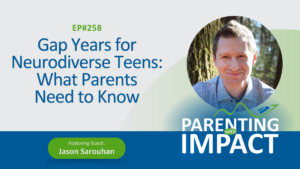
Article continues below...
Want to Stop School Struggles?

What to expect in this episode:
Find Parenting with Impact on your Favorite Player:
About Jason Sarouhan
Connect with Jason
Related Links:
Connect with ImpactParents:
Our Discussion
I was not fortunate enough at 18 to have heard about this concept of a gap year and went straight on to college. But I did take what would have been considered gap time in college. I spent time on this highly experiential program in school, and it inspired me so much to want to provide these opportunities for others that once I graduated from UC San Diego, I ended up going off to begin my training to become a wilderness-based leader, leading trips throughout the United States. I started leading trips internationally. I had quite a bit of experience in Tanzania and Kenya and ultimately was hired by a gap year organization to run their programming in Africa and Asia, working as a program director. I then moved into more of an executive director position at some point.Want to Stop School Struggles?

Find Parenting with Impact on your Favorite Player:
Amazon Music | iHeart | Spotify | Apple Podcasts | TuneIn | Youtube