
PARENTING WITH IMPACT PODCAST
How To Build Self-Trust and Emotional Regulation with Autism and ADHD with Taylor Heaton(podcast#260)
Supporting your kid starts with supporting yourself, and that’s especially true if you’re a neurodivergent parent. In this episode with Taylor Heaton, we’ll explore the importance of rest, routines, and trusting yourself when it comes to self-regulation, and what a later-in-life diagnosis can do for parents who might be struggling. Join us for insights on understanding yourself to parent with clarity and confidence. Download a free tip sheet "Recommended Treatment for ADHD: Medication & Behavior Management" for what's really recommended for your child or teen. How To Build Self-Trust and Emotional Regulation with Autism and ADHD with Taylor Heaton Amazon Music | iHeart | Spotify | Apple Podcasts | TuneIn | Youtube Taylor Heaton is a content creator, autism advocate, and the voice behind Mom on the Spectrum, a platform dedicated to raising awareness and understanding of autism through the lived experience of motherhood. As a late-diagnosed autistic woman and parent to autistic children, Taylor shares honest, relatable insights on neurodivergence, parenting, sensory challenges, and navigating everyday life on the spectrum. Through her content, she helps normalize autism, reduce stigma, and provide support to families and individuals seeking validation, education, and community. Her work blends storytelling, advocacy, and practical tools to help others better understand themselves and their loved ones. Taylor Heaton I didn’t anticipate life looking like it does today. My background is in music, so I got my degree in flute performance, and I was a private flute teacher for a while. But over the years, I’ve always known my brain was really different, and I’ve strived to find someone who could help me understand why I process things so differently. I would see other people work things out, and I would know that however I did it, it wasn’t that way. And so over the years, through therapy, I had different terms shared with me, OCD, ADHD, those kinds of terms helped me put things in perspective. But it wasn’t until about 5 years ago, when I was 31, I had a colleague who told me that her daughter had just been diagnosed as autistic. And I thought, well, if she’s autistic, then maybe I don’t understand what autism is, because we had gone to school together, and she seemed to be socially very capable, and we had a lot of similarities. And so that kind of lined up along with the timeline of my son, who’s my youngest child. He was presenting with some very challenging behaviors when he was a baby that I wasn’t sure how to support. So as I was learning about that, and my colleague was sharing this news with me about her daughter, it started opening my eyes. Like, well, if this is autism, then this could be me. So I received my diagnosis about 5 years ago, and it changed my life so much and also not at all. It changed everything and nothing, but in a way that completely empowered me to live with more compassion and understanding. And so I made a couple of videos about it on YouTube, and they generated some traction, and here I am 5 years later still educating and advocating for the autistic community. Elaine Taylor-Klaus That’s amazing. There are so many places I could go in this conversation. We have a lot of parents of young adults listening, so I want to create some context here. Part of what happened is that you identified this at a time in your life, and in the world, where if you had been evaluated 10 years earlier, you likely would not have been diagnosed with autism. For those listening, the DSM changed, and our understanding of autism shifted around 2013. We’ve also learned that autism can present differently in females than in males, so a lot has changed in the last 10–15 years. So as you began to explore this, I want to go back to your experience. What did you do to shift the myths and begin to understand what was really happening, as opposed to the old notion that if you weren’t a nonverbal boy, you didn’t have autism? Taylor Heaton Right. There was one term in particular that really set things off for me. My colleague mentioned that her daughter had a lot of copy-and-paste behaviors, and I knew instinctively what that was, even though I had never heard the term before. It’s the practice of watching other people and formulating your responses based on what they’re doing, copying behaviors in order to be accepted in a group. That really piqued my interest and led me to reach out to a friend who had been diagnosed. Honestly, just sitting down with an actually autistic person felt like coming home. I was coming from a place of curiosity, asking questions, learning from her lived experience, and being open to the idea that maybe I had it wrong. Maybe my understanding of autism wasn’t current. That curiosity, combined with connecting to someone with lived experience, really opened the door for me. Elaine Taylor-Klaus When you think about what it was like for you as an adult to be identified with autism, having not known all your life, we could go into what might have been different if you’d known earlier, but I want to stay with your experience as an adult. I know what it was like for me being diagnosed with ADHD in my 40s. What was it like for you? You said it changed everything and nothing. Taylor Heaton Yeah. Like I said, I always felt like my brain was different, like I wasn’t like other people. The ADHD and OCD labels gave me some language to understand myself, but when I finally learned about autism in an updated and accurate way, it felt like coming home. Before that, it was like I was constantly asking, “Do you understand me? Can you help me understand my brain? Who am I?” And then I found this term, and it was like, I don’t have to ask anymore. I don’t need to keep searching. It gave me a framework to understand my challenges. I could stop looking under every rock. It was like, this is it. I can finally catch my breath. Elaine Taylor-Klaus And when you say, “this is it,” what does home feel like for you as an adult with autism? Taylor Heaton Home feels like not trying to find a rhyme or reason for why I am the way I am. I say that knowing that, generally speaking, for autistic people, understanding the why is a huge driving, motivating factor all the time. But home feels like not questioning myself. That’s one of the things I teach a lot in the connection groups that I run. A lot of times, autistic people have lost touch with our sense of intuition, which actually is incredibly accurate. But especially for late-diagnosed autistic people, we’re often told that we’re too sensitive, we’re overreacting, we’re overthinking, we’re too complicated, we need too much. So the messages we internalize are, “I’m too much,” “I’m oversensitive,” maybe my body is lying to me, when all along our body has been giving us very accurate cues about what’s safe, what’s dangerous, and what we need to be cautious about. So feeling at home, for me, is regaining that connection to my sense of intuition and trusting my body. That’s a lifelong process, but I’m definitely finding more safety there, and that feels like home. Elaine Taylor-Klaus And here’s my full disclosure. One of my kids was diagnosed at 29, so I have a recent and familiar experience with what you’re talking about. I’m thinking back to years of intense highs and lows, and significant sensory issues. Can you talk a little bit more about regaining trust in your body? Because there’s the body and then there’s the behavior, and I want to separate those for a moment. Taylor Heaton The body and the behavior. So trusting my body… something that’s been really difficult for me is trusting when I need to rest. I’ve never known what it’s like to live in a non-autistic body, but from the work I do within the autistic community, I feel like we need a lot more rest than most people, and that’s OK. Not only is it OK, but it’s really necessary. I’ve noticed that autistic people tend to work in spurts. We might have long, prolonged periods of focused interest, followed by a need for intense rest. So I’ve started building more opportunities for rest into my schedule. I anticipate that I’m going to need rest before I reach burnout. So allowing myself to respond to that need for rest has been really important. And then there’s also getting in touch with my body. This might seem a bit paradoxical, but it’s also about understanding mentally that my interoception is sometimes off. Taylor Heaton Interoception is the body’s ability to recognize internal cues like hunger, thirst, needing to go to the bathroom, or needing to rest. For many neurodivergent people, that response can be delayed. You might not realize you need to go to the bathroom until it’s urgent, or you might not realize you’re hungry until you’re extremely hungry and upset, which happens with my kids a lot. So I try to build in intentional opportunities to connect with my body. Even before I feel hungry, I know I need to eat, so I keep snacks nearby. I have a little drawer with my work snacks. Checking in regularly and staying hydrated is also really important. It sounds simple, but especially for neurodivergent people, staying hydrated is one of the easiest ways to stay connected to your body. Drinking plenty of water can make a big difference. Elaine Taylor-Klaus It’s so funny you say that, because when my kids were little, I used to tease that I was a water pusher. Taylor Heaton It’s important. It’s an important job. Elaine Taylor-Klaus Super, super. But I never figured out how to write the articles because it always just came out sounding wrong. So eat snacks, drink water, pace yourself, get rest… it sounds like the prescription for every healthy human, and yet there’s this higher need, is what I’m hearing. Taylor Heaton Yeah, it’s like an overarching framework. Like I said, it’s kind of a body-and-mind thing because with autistic people, we can trust our body, but we also have to work in tandem with what we know. That’s why diagnosis is so important. With what we know about autism, it’s like, OK, I’m going to have to help myself out with some cues here. I’m not always going to know immediately when I need to eat or when I need to rest, so we can support ourselves by setting some of those things up ahead of time. Elaine Taylor-Klaus My guest is Taylor Heaton from Mom on the Spectrum, and we’ve been talking about body awareness and how that helps in managing life as an adult with autism. I want to shift over to behaviors. What’s required of us as humans, as adults, as parents, and how is that different when we have autism? Because you said you had OCD and ADHD diagnoses early on, and then autism is what really landed. Did those diagnoses turn out to also be true, or were they mischaracterizations on the way to autism? Taylor Heaton I think they very much also turned out to be true. Autism helps contextualize everything and makes sense of more things. A very high number of autistic people are also ADHD and/or OCD. I’ve actually thought about this a lot. I think because I’m autistic, the pattern-seeking part of my brain helped me early on. I had a therapist who helped me identify OCD, and it was like that part of my brain said, “I see it, I recognize it, I understand it.” I read a book called Brain Lock, and that really helped me understand the complexities of OCD. So I feel like I’ve had a long stretch of time where that has felt less challenging for me. But I definitely identify with the ADHD part of my brain. It often feels like a battle between ADHD and autism: “Let’s be spontaneous.” “No, let’s rest under the weighted blanket.” “Let’s try something new.” “No, let’s stick with what we know works.” So there are constantly a lot of different ideas going on in my brain. Elaine Taylor-Klaus I so resonate with everything you’re saying. I’m curious about executive function, how you manage organization and structure as a mom with all of this going on in your brain. What do you have to share? Taylor Heaton About how to stay organized? Elaine Taylor-Klaus Yes. What’s the challenge for you? Does the OCD balance the ADHD? How does it work? Taylor Heaton I think staying organized is one of my coping strategies. When my house is clean, it helps my brain think better. I’m actually divorced, which has been a positive change in my life, and every other weekend I don’t have my kids. That time becomes a reset for me. I can get my home back in order and return to a framework that feels good for us. I’m also learning how to teach my kids to help with things around the house. What I’ve found helpful, and every neurodivergent kid is different, is creating a checklist together. We’ll look around and ask, “What would help us feel better? What do you notice?” Maybe it’s picking up dirty clothes. We create that list together and I give them autonomy. I’ve heard you talk about this as well, how important it is to build autonomy in children. You don’t have to do this right now, but these are the things that need to get done. And when you get done, we can all watch a movie together or whatever. So we have family check-ins around that. I do know that one of my coping strategies is to stay on top of things. My mom and I are very similar, we’re constantly picking up our space and cleaning as we go. That’s kind of how it works every year, but I don’t have a magic solution. We’re learning as we go. Elaine Taylor-Klaus I joke with my husband all the time that you might have a little OCD, you just don’t always have it in the places I need you to have it. Taylor Heaton Yeah, if you could just focus it in a particular area a little bit more. Elaine Taylor-Klaus So I know you have a community of parents dealing with these issues. If organization isn’t a natural default, or if there’s demand avoidance, which adults with autism often struggle with, how does that shift, maybe not in your experience, but in the experience of people you work with? Taylor Heaton If organization isn’t something that comes naturally, there are different options. Some people in my community benefit from gamification, finding ways to reward themselves. There are lots of ideas out there about turning tasks into games. Some people like color coding. One of my friends organized a drawer and made it her weekend project, finding creative ways to do it. I think at the center of all of this is emotional regulation. Understanding how you feel when your space is disorganized versus when it’s clean. Let yourself sit with that without shame. How does it feel when your desk is a mess? How does it feel when it’s clean? And then, with demand avoidance, you still have choice. You can choose to leave it messy, or you can choose to take action. Focus on how that choice makes you feel and how it impacts your day. I think shame is something that often works against us. So when you notice shame around habits, just acknowledge it. Don’t try to force it away. What you resist persists. Instead, give yourself a small action step. Even a small step forward can create a sense of agency and build momentum. Taylor Heaton And speaking of momentum, autistic inertia is a real thing. For autistic individuals, it’s the idea that a person at rest stays at rest until a major force acts on them, and a person in motion stays in motion unless a strong force interrupts them. So if you can get started with something small, it can help create forward movement. If you’re stuck in bed, maybe it’s just putting your feet on the floor, going to the bathroom, or doing one small task. That can start the snowball effect. Elaine Taylor-Klaus I love that term. I think I’ve heard it before, but not described like that. Can you talk a little more about inertia before we start wrapping up? Taylor Heaton It’s been a really helpful concept for me. Especially with ADHD tendencies, I like to think about this in a work context. A lot of neurodivergent people don’t thrive in a traditional 9-to-5 schedule. When we have a creative idea, we go all in. We work intensely until we can’t anymore, and then we need rest. This connects to autistic inertia. Once we get started on something, it can be very difficult to stop. And if we’re interrupted during hyperfocus, we might become irritable or reactive because we were in that flow state. On the other side, if we’re stuck and not in motion, it can be hard to get started again. So this concept has helped me be more compassionate with myself. I know I’ll find momentum again, even if it starts small. Another important piece is difficulty with transitions. Moving from a flow state to rest, or vice versa, can be really challenging. That transition space can feel confusing or overwhelming. Understanding that this is part of the neurodivergent experience and having language for it makes it easier to navigate. Elaine Taylor-Klaus Yeah. I’m listening to you, and I’m thinking I could say the exact same thing about ADHD. Taylor Heaton It’s very common, ASD, this notion that… Elaine Taylor-Klaus It’s about self-regulation, right? And so if I’m having a hard time getting myself to feel or do whatever it is, whether it’s ADHD or ASD, I need some stimulus to try to make that happen. Right? Taylor Heaton Yeah. And some people in my community have shared something that doesn’t particularly work for me, but I think it’s worth mentioning. Sometimes having a connecting element between transitions can help. For example, listening to an audiobook or music can create a bridge from one phase to another. That continuity can make transitions smoother. So if that helps anyone, I’ll throw that out there, because it works for some people in my community. Elaine Taylor-Klaus We play a lot with an acronym we call PINCH, which are five motivators: play or creativity, interest, novelty, connection, collaboration, and urgency. Sometimes finding that connecting element, like you said, can really help. Taylor, it’s fascinating to talk to you. Thank you for sharing. Is the best way for people to find you through Mom on the Spectrum Life? Taylor Heaton Yes. I’m also on YouTube, you can search Mom on the Spectrum. That’s where I am primarily. I also have an online community that you can find through my website. The thing I’m most proud of is my connection groups. These are weekly opportunities for autistic adults to come together. Coincidentally, this week’s topic is parenting, specifically autistic parenting and parenting neurodivergent children. Each week we focus on a different topic, and there are many ways to participate. You can listen with your camera off, participate in the chat, or share out loud. We’re really working to support different communication styles. These groups are very special to me. If you’re an autistic adult looking for a space where you can feel seen without being pushed too far outside your comfort zone, I’ve worked hard to make these groups accommodating and inviting. I’d love for you to check them out. Elaine Taylor-Klaus Beautiful. Before we wrap, is there anything else you want to share that we haven’t covered, or something you’d like to highlight? Taylor Heaton What’s been coming up for me recently, especially with the state of the world, is how important gentleness and slowing down are. Slowing down helps regulate us. It helps us emotionally center ourselves. The pace of life is exhausting, and there are opportunities for us to slow down, whether that’s getting off our phones or spending more time in nature. We’ve all heard these ideas before, but actually putting them into practice can be life-changing. Being gentle and kind to yourself creates ripple effects, not just for you, but for your family and your community. So if you’re feeling tired or overwhelmed, slow down. Be kind to yourself. Give yourself time and space to feel instead of constantly reaching for distraction. Even though that can feel uncomfortable, it’s actually the way forward. It’s a shortcut to hope and peace compared to staying stuck in the constant busyness of life. So those are my two cents, a shortcut to hope and peace. Elaine Taylor-Klaus That’s great. Before we wrap, Taylor, do you have a favorite quote or motto you’d like to share? Taylor Heaton I pulled this one up because you mentioned you were going to ask. I do have several quotes, but I wanted to share one from Fred Rogers, because he’s one of my all-time favorites. Given the state of the world, I feel like he was always such a voice of hope and compassion. I found one that I think applies to parenting and showing up courageously right now. “Love isn’t a state of perfect caring. It’s an active noun. Like struggle. To love someone is to strive to accept that person exactly the way he or she is, right here and now.” Elaine Taylor-Klaus Love that. He was a hero of mine too. Taylor Heaton I loved him so much. Elaine Taylor-Klaus He was great. Mister Rogers, beautiful human being. Taylor Heaton Yep. He really was. Elaine Taylor-Klaus Thank you. Thanks for being here. Thanks for sharing your wisdom, your insights, and your journey with the world. Taylor Heaton You’re welcome. Thank you for inviting me. I really appreciate the opportunity. Elaine Taylor-Klaus My pleasure. To those of you listening, take a moment. Reflect. What are you taking away from this conversation that Taylor and I have had? What’s your insight, your A-ha, your gem? As you take a breath and let it out, is there something you want to apply in the coming week? Maybe you want to pace yourself a little more, slow things down, or step outside and feel the grass under your feet. Maybe there’s a conversation you want to have, or a way you want to take care of yourself with gentleness and kindness. How do you want to apply this to your life this week? And as always, my friends, thank you for being here, for tuning in, for doing what you’re doing for yourself and for your kids. It makes an extraordinary difference. It is a true act of compassion, and in some ways, it’s almost an act of resistance to slow things down and pay attention to yourself and the role you’re playing. So, yay you. Bravo. Thanks for being here, and we’ll see you next time. Download a free tip sheet "Recommended Treatment for ADHD: Medication & Behavior Management" for what's really recommended for your child or teen.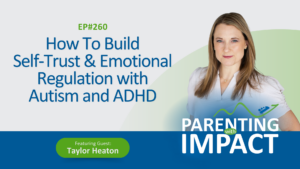
Article continues below...
Treatment for your Child's ADHD
What to expect in this episode:
Find Parenting with Impact on your Favorite Player:
About Taylor Heaton
Connect with Taylor
Related Links:
Connect with ImpactParents:
Our Discussion
Treatment for your Child's ADHD

Find Parenting with Impact on your Favorite Player:
Amazon Music | iHeart | Spotify | Apple Podcasts | TuneIn | Youtube