
PARENTING WITH IMPACT PODCAST
After the Diagnosis: Raising a Neurodivergent Child (EP287)
When your child gets an ADHD, autism, or other neurodiverse diagnosis, there’s often relief. Finally, the struggles you’ve been facing have a name. That’s immediately followed by the question… now what? Download a free tipsheet, "10 Tips for Calm & Confident Parenting." Use the coach-approach to change the tone in your home or classroom -- starting now! That’s the question Nefertiti Austin set out to answer in her book She’s Just Spirited. In this episode of Parenting with Impact, Elaine sat down with Nefertiti, a professor, author and adoptive mom, to talk about raising her neurodivergent daughter in a conversation that’s more mom-to-mom than interview. Nefertiti’s daughter was diagnosed at six. In kindergarten, she’d had one teacher assigned to her alone, while the other taught the rest of the class. The school told Nefertiti to wait. She didn’t. “If you have to redirect her 50, 60 times per day, something is amiss.” The diagnosis brought relief. It also sent her right back to square one. She’d raised her son, about six years older, and thought she had this parenting thing down. (Surprise!) Nefertiti did what so many of us do, the thing we call the pinball of parenting: provider to provider to provider. OT. Therapy. A glittery checklist taped to the desk. Check, check, check. And nothing changed. The tools weren’t the problem. The expectations were. Nobody told her what to expect, so she figured a few months would get things on track. When that didn’t happen, she started asking more critical questions and got much better at telling who and what was actually helping. Nefertiti realized she had to go at her daughter’s pace. Ebb and flow. Forward, back, sideways. And she kept checking in with her: “Is this working for you?” She accepted that her daughter was her own person, and she refused to dampen that spirit. Underneath it all was something emotional: when her daughter started saying “I’m bad,” everything shifted for Nefertiti. “We have to do something…I didn’t want her to feel that way. I don’t want her to hurt.” By fourth or fifth grade, Nefertiti could see it clearly. The teachers and providers who’d insisted her daughter fit into a box that didn’t fit her were wrong. So she trusted her instincts, let her daughter’s needs guide the ship, and found a school that said, “We got her.” Elaine had her own version of that moment, realizing that if she kept trying to get her kid to live up to everybody else’s expectations, it was going to crush her. You can hold them in the box at their peril. Or you can trust. Nefertiti closed with something important for adoptive parents, parents to children of color, and educators. When you add race to neurodivergence, it’s a whole other layer. Kids often get labeled negatively before anyone stops to ask whether they should be assessed for autism, ADHD or dyslexia. Her ask? Give all kids the benefit of the doubt. Don’t fall into what I call the moral diagnosis. As Ross Greene says, behavior is a symptom that something’s going on that needs support. Find Nefertiti on Instagram at @iamnefertitiaustin. Look for She’s Just Spirited: Parenting a Neurodivergent Child and the Diagnosis That Changes Everything in our reading carousel. At ImpactParents, Elaine and Diane talk about this all the time: what our kids need most from us is our vision of their potential. Especially when the rest of the world keeps telling them they might not be okay. So what’s your aha from this one? How will you carry it into your week? After the Diagnosis: Raising a Neurodivergent Child Amazon Music | iHeart | Spotify | Apple Podcasts | TuneIn | Youtube Nefertiti Austin is an adjunct professor of History and African American Studies, a speaker, and the author of two books exploring race, motherhood, and neurodiversity. Her newest book, She’s Just Spirited, offers a lens into parenting a neurodiverse girl — navigating schools, therapists, and the emotional terrain of raising a child whose spirit is worth protecting at every turn. Elaine: Welcome back to another conversation in the Parenting With Impact podcast. Have you ever considered what happens when parenting challenges everything you thought you knew? Have you had that experience? I know I have. When it challenges everything you thought you knew about connection, and about identity, and about resilience. Today, we’re talking with Nefertiti Austin about adoptive parenting, neurodiversity, and raising what we like to call complex kids with honesty and heart. Welcome, Nefertiti. It’s great to have you here. Nefertiti: Thank you so much. Great to be here Elaine: So I wanna start by asking you to introduce yourself. We don’t do formal bios here. I want you to, to, to briefly tell your story of kind of who you are and how you came to be sitting here on this podcast with me having this conversation, because you’re a professor at a university in history and African American studies, and this was not exactly the path you expected to be on. Is that fair? Nefertiti: That’s fair. That’s fair. Okay. Um, so I am, as you said, Nefertiti Austin. I am a proud Los Angelino, and I had two goals as a young kid, young teen through early undergrad, and that was to be a lawyer and to be a writer. And I had read James Baldwin, like in middle school, Go Tell It on the Mountain, and I was like, “Yes, that’s it. That’s, that’s what I’m gonna do, but I’m gonna be a lawyer because I, I enjoyed what I thought the law meant what it meant to be Elaine: cause I have a similar story. I love that. Thank you for that … Nefertiti: a teenager. And, um Elaine: We thought the law was about justice, right? Nefertiti: Absolutely. And having participated in moot court, I was good at debate, and I thought these were the things, and I got to law school and I was like, “Oh my God, I am bored to tears.” And I think the stress of it all really sort of pushed my writing forward, so my first book was written during my first year of law school, and it was great for me because it really opened my world up, especially when the school I was at was like, “Yeah, you should probably not return next year.” I was like, “Great, I’m off the hook.” And I briefly transferred to another law school, and it was really a couple of really good friends who were like, “You don’t even like it, so what are you doing?” And so it was just like a light bulb moment, like, why am I doing this? And I knew why. Because I was trying to please my family. Elaine: Oh. Nefertiti: And I had really sort of constructed this, um, person that I was going to be, and then when it stopped looking the way everyone thought it should look, um, including myself, I had to make a decision. I was at a crossroads, and ultimately it was a very easy decision, and I don’t regret that year. Definitely learned to think a little differently having- attended law school. However, that was not my path. That was not. So I worked for a little bit, and then I went to grad school- And, um, after that, I mean, I’ve had the good fortune to work in, like, just music business and politics and, and then ultimately becoming a professor at a community college versus a university. One, I don’t have a PhD, don’t want one, and two, I don’t have to publish. And so I was back on my writing. How, what job will afford me time so that I could write? And so, and explore other interests that I have. Elaine: Beautiful. So fast-forward to you ended up writing a book called She’s Just Spirited because of your life experience. What was … So what, what, what’s this about? Nefertiti: Well, I wrote this book about my daughter who is neurodivergent, and I had written a book previous to that called Motherhood So White, and it was more about my journey as an adoptive parent raising a Black boy in, in white spaces and those experiences. And I knew as my kids got older, there was no way I’d get out of this lifetime having written a book about one child and not the other. And, um, so originally I was gonna write about relationships between mom and daughters, and ultimately my agent and I had a conversation. And really, as a parent, I mean, it’s my lens as a parent navigating school and therapists and diagnoses and so on and so forth that I put into the book. And as a girl, um, it, girls are treated differently and even though they’re diagnosed more or less at the same rate, girls are diagnosed later. And so just really kinda getting to, oh, this is why the teachers missed it, oh, this is why we had trouble in school and why we had to change schools. And just in speaking with other parents about my experience, it ultimately became I’m answering the same questions over and over, I should put it on paper. Elaine: Beautiful. Beautiful. So, uh, is there, is there a big, the biggest question … So, I’m sorry, let me step back. So you’re a mom of adopted kids. Is that correct? Nefertiti: Yes. Elaine: And, um, is there a question that you get asked more than anything else? Is there a primary question? Nefertiti: Uh, not so much. We look alike, so that kinda skips the, you know, “Oh, whose kids are those?” sort of thing. And I forget that they are adopted too, so I just think the way in which we interact with one another, I mean, they didn’t come out of my body, but they may as well have. So not so much anymore. They’re both very tall, and so I guess the big question I do get, “Is your husband tall?” That’s what I get the most. Elaine: Right. Okay. So what was the question you were trying to answer in this book? Nefertiti: So in She’s Just Spirited, I was trying to answer- You get a diagnosis, and then what? So then what? That’s the question that I was answering for parents, because it does open Pandora’s box. And there’s so many different ways that you can go in answering that question. So just to kind of keep people from falling down the rabbit hole. And if you get in the rabbit hole, just knowing you can get out of the rabbit hole and, and keep moving forward. Elaine: Yeah. That, I’m, I’m so with you. Um, how old was she when she was diagnosed? Nefertiti: Six Elaine: Okay. Yeah. I’m with you. I was at five. Nefertiti: Yeah, yeah. Elaine: But also 25 years ago, so. Nefertiti: Okay, okay. Elaine: Easier to fall through the cracks. But so, and, and what I’ve seen in the, in the years of doing this work is when you’ve got a kid who’s diagnosed at six, at four, five, six, you’ve got a, what I would call a, a healthy dose of whatever the diagnosis is, whether it’s ADHD, autism, anxiety, whatever it is, if you’re catching it as a diagnosis that young, it’s pretty prevalent. Is that fair? Nefertiti: Yes, yes, it was definitely pronounced. I mean, her kindergarten teachers, she had two teachers plus an aide, and I’m having a conversation with one of them and she’s like, “We’ve got one teacher on her, and then the other teacher for the other kids,” because she’s turning cartwheels and wouldn’t sit still and all the things. And so I said, “Oh, okay, something’s amiss. You know let’s find out what’s going on.” They’re like, “Oh, no, she’s young. You can wait.” And I’m like, “No. If you have to redirect her 50, 60 times per day, something is amiss, and let’s just find out, you know, what it is.” Elaine: So how did you feel when you got the diagnosis? Nefertiti: A relief to some degree, because it sort of named at least some of the behavior of, of what was going on. And, um, and then also it kind of, I’m like, “Oh, wow, I’m in uncharted waters, and now what do I do?” is basically what I was thinking, because my son is about six years older than his sister, very different kids, very different experience. And I was patting myself on the back until my daughter came, thinking I had just done this amazing job, and now I’ve got this child who’s got a diagnosis that she’s always gonna have. And so I felt like I was, I was back at square one as a parent. Elaine: I had a client when I first started coaching, so this is back to like 2010, 2011. I’ll never forget the word she used, ’cause she had an older daughter, and then this kid who was adopted was throwing her for a loop. And she said, “This is not my first rodeo.” Nefertiti: Right. “ Elaine: But what I did in that one is not working in this one.” Nefertiti: Oh, 100%. Totally different kids. Yes. Elaine: Yeah, totally different. Mm-hmm. So, so you have this kid that you get a diagnosis pretty young, and, and I really wanna acknowledge that just saying, “Okay, now what do I do?” is a shift for a lot of people. Um, were you, was your overwhelming sense, I gotta take care of this? Was it I am worried for her future? Is it what, like was there an emotional component to it in the early months, year? Nefertiti: Well, I’m very solution-oriented, so I immediately went into action. I’m super action-oriented, and so I went into what do I do? Who do I go to for help? Like, what’s next? Who do I call, and where do I go to get her services? So I didn’t get on the what, what her future looked like until a couple of grades later. But in the early moments, it was like, “Okay, what do I do? Where do I go from here?” And I was very transparent with her teachers and the administration when I found out, because I didn’t want her to be treated differently. She was already being treated differently, but I didn’t really want that to happen, so I felt like, okay, well, if I’m transparent and I’m letting everyone know, hey, this is the situation, I felt like that would mitigate some of the emails that, of course, I was starting to get on a regular basis. Elaine: Regular basis. All right, let’s take a quick break and come back. Nefertiti: Okay. Elaine: Welcome back everybody. My Nefertiti is Nefertiti Austin, and we’re talking about the lived experience of raising a spirited child, uh, who is neurodivergent and complex as we call it, and, um, who changed the playing field for Nefertiti’s life as a mom, really. And so you get her diagnosed. You, you dive into action. You start looking for resources. You don’t want her to be treated differently. All of this is so familiar, I gotta say, to me, right? My experience, um, those first 10 years for me, like, were just therapist after doctor after provider after, you know, you name it, I was gonna try it to try to… Because I wanted her to feel like she was having a normal childhood. Nefertiti: 100%. Elaine: Right? And yet it’s not a typical childhood when you’re going from doctor to therapist, even if they like occupational therapy, which- Nefertiti: Absolutely … Elaine: thankfully they did. Um, so, so there’s that. And at what point did you recognize that provider to provider to provider, that what I call pinball of parenting, um, wasn’t actually enough? Nefertiti: I, you know, it’s hard to put a clock on things, but I know early on I kind of thought, “Okay, well, if we go to OT and, and she does occupational therapy and we go, you know, 10, 11 times, well then now it’s magic and she’s gonna be able to sit still.” If she goes to speak to the therapist once a week, then, you know, same thing. After a few months, she will be able to regulate. And if she creates a list in glitter and all the things, and we tape it to her desk, and we do all of these things, she will be able to stay on task. And so- Elaine: So can I just call out what I, what you just said through my lens, right? What happened was you had these expectations- Nefertiti: Yes Elaine: that the providers weren’t really redirecting. Nefertiti: Right. Elaine: Right? They don’t really tell you what to expect, you know? Yeah. And so you’re like, “Well, three months from now we should be all fine, right?” Nefertiti: Absolutely. That’s a huge mistake, and I didn’t know it was a mistake, because I thought they’re giving me tools, I’m implementing every single tool. I’m following, you know, I’m going up the line. Check, check, check, check, check, and nothing has changed. Yeah. And so then that kind of gave me permission to be a little more critical thinking with the people that we met. Okay. And then I developed, I think, more discernment about, “Okay, oh, you guys are all working from the same playbook. Like, that doesn’t work. That’s not helpful.” So. Elaine: Okay. Nefertiti: Yeah. Elaine: Relatable content to me. Okay, so, so you begin to realize that your expectations are out of sync with what you’re getting. Nefertiti: Yes. Elaine: And, and maybe out of sync with what’s possible for this kid, I’m guessing. Nefertiti: Yeah. Absolutely. Elaine: Okay. So let’s, let’s talk about that, that, that parent, that parenting mindset shift from, “Let’s fix this,” to, “Oh, we’re not gonna fix this.” So what, what… Talk a little bit about that experience. Nefertiti: Really learning the hard way after multiple tries and failures that I had to go at her pace, and that I couldn’t will whatever I wanted to happen into reality. And I had to learn that it really wasn’t so cut and dried. It wasn’t just follow A, B, and C and it’s gonna work out. It was, oh, I might have to mix, you know, A with M and then throw B. You know, it was a lot of … and then we might regress for a little bit, and then we move forward, and then we might regress a little bit, and then we move sideways. I had to really just learn to kind of move with her. Just a lot of ebb and flow, and I just had to be very fluid with what she was experiencing, and also checking in with her and asking her, “Is this working for you?” So the- “Are you getting anything out of this?” Elaine: So. So, so the, the first question I had blends to the second. So what you just said, I want to, I want to pin that and come back to the part with her. But before that Nefertiti, when you look back on it- What did you accept that changed the course for you? Nefertiti: Well, I accepted early on that she was her own person. And initially, I honestly thought, “Oh, she’s just spirited. She is a force to be reckoned with, and I definitely…” You know, she’s a teenager, so it gets on my nerves at this moment, but I love that about her. Yeah. And what was important to me was that she never lose that. And so in this journey, as she was a little girl, I didn’t wanna tamp down her spirit ever. And so I guess maybe what came to me was really like, what is the best way to support who she is in the midst of trying to follow these rules? Because on the surface, I am a rule follower, but probably not really. And so then I just had to remember who I am. Like, okay, well, you know sometimes these things don’t work, so let’s do it different. Elaine: So there is an acceptance that she is an, her own person. There’s an acceptance that I have to meet her where she is. And, and that I’m gonna follow the rules until the rules don’t work for her. Nefertiti: 100%, yes. Elaine: Right. So that’s a few pieces. Um, if I go under that right, underneath the, the, those kind of structural pieces, was there an emotional piece that you accepted that changed things for you? Nefertiti: I, I hurt ’cause she hurt, and so because she felt and started saying, “Oh, I’m bad,” you know, absolutely not. You know, that’s not language we use, and I didn’t want her to feel that way. So my emotional cues I guess I also took from her, and when she started to feel bad about herself, that was like, you know, oh no, you know, we, we have to do something. So I really had to learn something I didn’t get as a kid. I wasn’t raised in, like, this super affectionate household. It was- we weren’t effusive with words, “Oh, I love you, I miss you.” We didn’t do stuff like that, but I’ve got a child who needs all of that. And so she really changed me. So emotionally, I had to really understand and I think tap into a part of myself that I well, obviously was there, but I hadn’t realized I was going to have to trot out intentionally and regularly for her. And so there was the emotional piece underneath all of it, which was I don’t want her to hurt. Elaine: Don’t want her to hurt. Nefertiti: Yeah. Elaine: I can so feel that. I told you before we started talking that, that, you know, this could turn into a mom-to-mom conversation more than an interview because our experiences are so parallel but 20 years apart. right? Or 10 years apart, whatever, 15 years. And, and I remember just so vividly that moment when I realized if I keep trying to get this kid to live up to everybody else’s expectations, I’m going to crush this kid. Nefertiti: Yes. Yeah. Elaine: And I can’t, and I can’t do that. Because that’s not what parenting is. Nefertiti: Yeah. No, 100%. Yeah, and it really, I think when I was writing my book, um, I didn’t have language. You know, you’re going through it, and you’re just the day to day of everything. So, you know, hindsight was helpful to be able to reflect upon. By the time she hit fourth, fifth grade, it was like, oh, wow, we were all wrong. All of the adults were wrong because we were all expecting and insisting that she fit into a box that she’d never fit in, and she was never going to fit into the box. And when I got that, and then when we left the school, it, I was great. I was like, you know, “Okay, we’re good,” because this was never gonna work out for her. Elaine: Yeah. I had such a parallel experience, and there were a lot of schools that we left. transparently. And, and the, the last one being between fourth and, not the last one, one between fourth and fifth grade. Um, and, and I just remember that decision that this is her life. And I remember writing a piece about, um, you know, her playing on a… everybody else is on this ball field, and this, this kid is over here playing, marching to the beat of a completely different drummer. And when you’ve got a kid like that, you can try to hold them in that box at their peril, and you’re hurt, and they’re hurt. Or you can trust. So, so talk a little bit, I know we have to start wrapping up in a little bit, but talk a little bit about what you ha- what you chose to trust in order to change gears. Nefertiti: Mm-hmm. Well, I chose to trust my instincts, and I chose to really lean into following her lead, like letting her needs guide the ship. And so it would’ve been easier in some respects to kinda stay where we were or stay nearby, or to make this big leap into, um, a school that said, “This is what we do all day long. We got her.” Just to trust, and they did, and they do, and it’s been fabulous and amazing. And also with her friendships and just her interactions with friends, really allowing her to come into her- so she had a lot of anxiety, which I didn’t realize. And that was interfering socially with relationships and things, and, and yet loves people, craves people. She’s so super social. Elaine: Feel that. Yep. Nefertiti: Yep. And Elaine: Our kids have gotta meet, honestly. Nefertiti: Yes, 100%. 100%. And, you know, we still she’s still a Girl Scout. Like, I didn’t hide her from anything. We still moved forward, and I just knew, okay, she’s gonna come into things maybe later than some of the other kids, but she’s going to get there, and that and it’s okay. It’s, it’s gonna be fine. Elaine: Great. That’s, that’s so huge to trust that she’s gonna get there. Like, we’ve done… There’s a lot of research on hope. There’s a lot of conversations in this podcast about what our kids need from us is our vision of their potential. And for when you saw, “She’s gonna be okay, I gotta do it at her pace,” she needed you to see that for her. Nefertiti: Yes. Yes. Elaine: In, in a big way. Yes. Not just a little way. In a bigger way than typical kids- Nefertiti: Yeah … Elaine: because the rest of the world is sending this message that you might not be okay. Nefertiti: Right. Right, and I knew she would be, know, know that she will be, and I would tell her that. Yeah. “You are going to be fine. You’re going… It, it’s great. It’s fine. You’re gonna be just fine.” Elaine: You know what I used to say? Hmm? “You’re gonna be an amazing adult. We just gotta get you there.” Nefertiti: Yeah. Yeah, I love that. Yeah, 100%. Elaine: Yeah. Nefertiti: 100%, yeah. And they’re, you know, more resilient, and that’s the other thing. I’m like, “For all of your experiences, you know, good, bad, and otherwise, you are so resilient.” And I’m like, “You’re so much stronger than you realize. Like, later it’ll catch up and you’ll be like, ‘Oh, wow, I can do these things. I can do things.” And when your friends are falling apart because they don’t have tools, you will have tools.” Elaine: Yeah. Yeah, yeah, yeah. So much more I’d love to, I’d love to just sit down over a glass of something hot or cold with you and just conversation. Um, let me take a moment to let people know how they can find out more about you. You have an Instagram called I am Nefertiti Austin. It’s on the, on the, on the page. Um, and we’ll have your book in our reading carousel, She’s Just Spirited: Parenting a Neurodivergent Child and the Diagnosis That Changes Everything. So all of that will be available for people in the show notes. Um, find out more if that is something interesting to you. Um, I’m looking forward to it. Uh, before we wrap, Nefertiti, is there anything we haven’t talked about today that you wanna make sure you share with the audience before we close? Nefertiti: I would love to share for the adoptive parents who are listening or, um, parents of mixed race children or of Black children, um, brown children, children of color. When you add race to neural divergence, and depending on the school setting, it really is a whole another layer. And often kids are, are labeled negatively before someone stops and considers, “Oh, maybe there’s something amiss. Maybe that child should be assessed for autism or ADHD or dyslexia,” or whatever the case may be. So as a parent, I would just recommend, and for, uh, educators, therapists who are also listening, is to give all kids the benefit of the doubt and maybe consider that there is neurodivergence at play as opposed to kind of falling into, um, biases, unconscious bias and just assuming, “Oh, that child is just bad,” or, “That child’s-” Right you know. Elaine: The, the moral diagnosis. Nefertiti: Yes. Yes. Elaine: Right. Nefertiti: Yeah. Elaine: Um, and I think that we have a significant percentage of members in our community that are adoptive parents. Nefertiti: Oh, great. Okay. Elaine: A lot of mixed race, et cetera, adoptive, you know, all of those issues you’re speaking to. And, and I really … I’m really glad you shared that, ’cause what I’ve seen, um, what’s interesting about adoptive parents is that they’re actually more likely to seek help because they don’t feel guilty or responsible- Nefertiti: Yeah … Elaine: biologically for, for what’s happening. So there’s more of a sense of, “I’m responsible for this kid. I’m gonna get the help I need to help,” which I love. Um, and, and what you’re speaking to in both race and, I would say race, gender, and adoption. Nefertiti: yes Elaine: um, is that there’s this amplified series of issues that show up. Nefertiti: Yes. Elaine: And so it may be the neurodivergence of an undiagnosed ADHD or it may be the dysregulation that comes from being, um, uncomfortable in, in your, in your own skin in the environment that you’re in. Nefertiti: 100%, yeah. Elaine: And so whatever the, the reason is, the, it, it’s a higher need to really get curious and understand what’s going on with that kid. You know, as Ross Green says, the behavior is a, is a symptom that something’s going on that needs support. Nefertiti: Yes. Yeah, 100%. I, I agree with that. Elaine: Um, all right. Thank you. Thank you for, for bringing this book into the world, both of the books, um, and for, for coming forward and talking about it. It’s a really important issue, and it’s lovely, to have… And this is, you’re, you’re not the first one, but, but it’s really nice when, when you’ve got somebody with the propensity to not only think, “I should write about a book- a book about it,” but to actually follow through and write the book about it. So I really want to acknowledge what that takes and, um, that it’s important that you bring this out into the world. So thank you for doing that. Nefertiti: Well, thanks for having me. Thank you. Elaine: Um, to those of you listening, take a moment and ask yourself, what are you taking away from this conversation? Maybe you have a kid that fits into the criteria, some of the criteria we’ve been talking about, maybe not, but what’s your insight or your aha from this conversation? What’s your awareness? And maybe how do you wanna bring that forward with you into the week that, the, into your week this week? And as always, my friends, and Nefertiti, thank you for what you’re doing for yourself and for your kids. At the end of the day, you make an extraordinary difference. And, you know, as a, as a P.S. note, please, if you like what you’re hearing on this podcast, we need your help and support. Please like, follow, subscribe. I just found out I should’ve been saying subscribe. I didn’t know that. So please, wherever you’re listening, even better, leave a review, but help us get the word out to more people who need this, these conversations, um, these authentic conversations about it, what it really means to be raising a complex kid. So thanks for that, and thanks for being here, uh, and I will see you in the next conversation.
Download a free tipsheet, "10 Tips for Calm & Confident Parenting." Use the coach-approach to change the tone in your home or classroom -- starting now!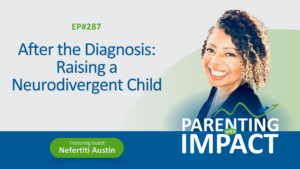
After the Diagnosis: Raising a Neurodivergent Child with Nefertiti Austin
Article continues below...
Want to Go from Chaos to Calm?

What do you do after your child gets a diagnosis?
Why isn’t therapy “working” for my kid?
What changes when you stop trying to make your kid fit the box?
How do race and adoption affect how neurodivergent kids are seen at school?
Where can I find Nefertiti Austin?
What to expect in this episode:
Find Parenting with Impact on your Favorite Player:
About Nefertiti Austin
Related Links:
Our Discussion
Want to Go from Chaos to Calm?

Find Parenting with Impact on your Favorite Player:
Amazon Music | iHeart | Spotify | Apple Podcasts | TuneIn | Youtube